
About
A working reference for the planted aquarium.
Fin & Stem started as a frustration. Care numbers were scattered across forums and product pages. Species were profiled in isolation. Nothing connected the fish to the plants to the shrimp to the gear that made them work. So we started writing it down, and connecting it. Today it's a living reference for aquascapers anywhere in the world.
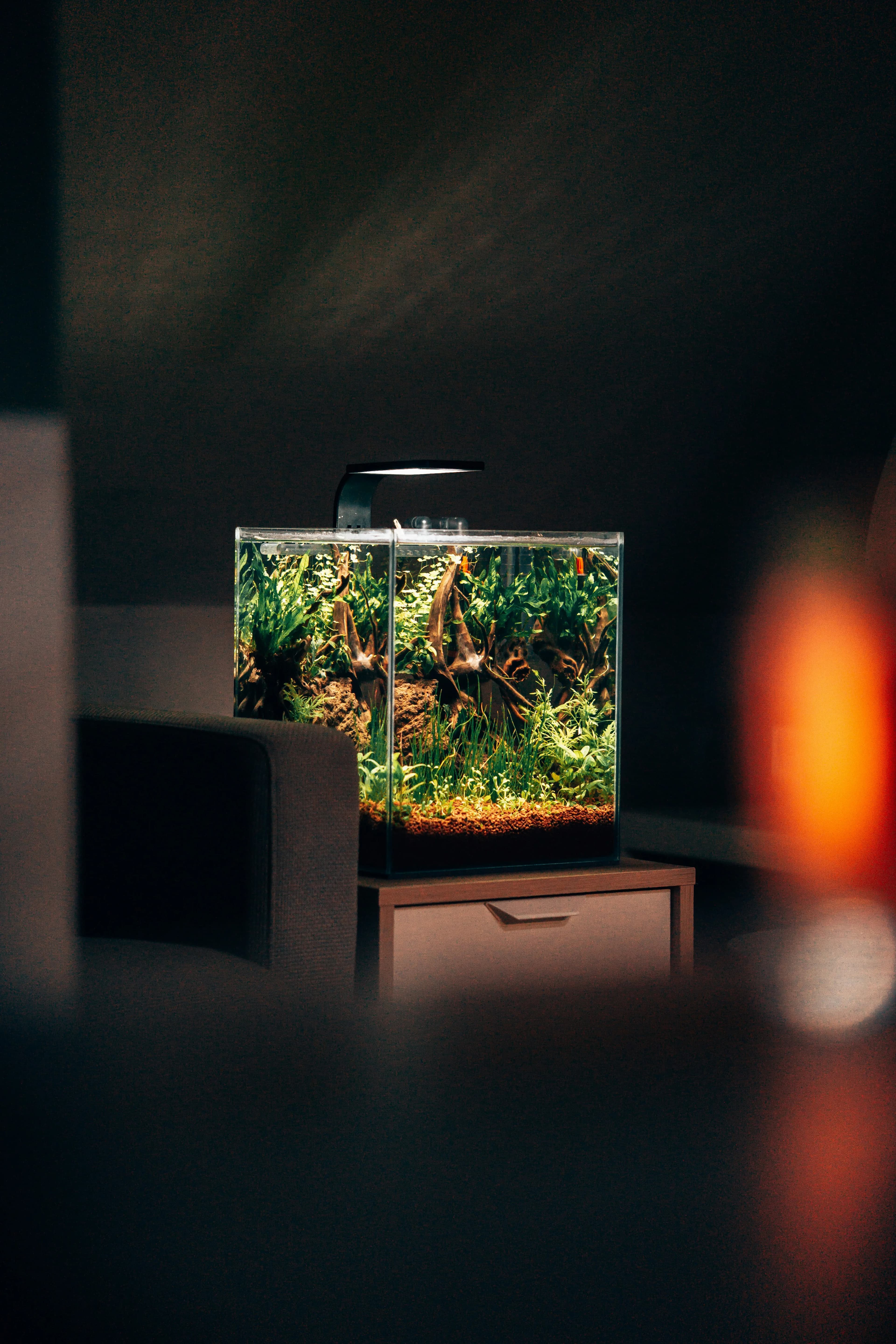
Photo: Szabo Gedeon· Unsplash
A reference for everyone who loves the underwater world.
Fin & Stem is a planted-aquarium reference. Care numbers, group sizes, light and CO₂ demand, tank-mate compatibility, written for the person stocking the tank, by someone who is still endlessly moved by what a glass box of water can become. Built to help aquascapers anywhere build the planted tank they imagined.
- 01
Original writing, sourced data.
Care ranges cross-reference FishBase, the IUCN Red List, Tropica's plant database, original species descriptions, and the documented experience of working aquascapers. Common-name and origin data tracks Wikipedia and Wikidata. We don't paraphrase competitor sites, if a number is from someone else, it's cited.
- 02
Connections matter.
Every species exists inside a system. Fish profiles flag plant and shrimp safety. Shrimp profiles list which fish they actually survive with. Plant profiles list their real light and CO₂ demand. The Compatibility page lets you anchor on any species and find what fits in your water. Cross-references are first-class data, not footnotes.
- 03
Imagery, properly attributed.
Species photos come from Wikimedia Commons (CC BY, CC BY-SA, CC0) and iNaturalist (CC BY and CC0 only, never the default CC BY-NC), with author and source recorded on every file and a back-link on every gallery thumbnail. Gear and hardscape photos are supplied by the brands and their distributors, and every product page links back to its source. The underwater world deserves to be shown by the people who actually captured it.
- 04
Honest about uncertainty.
Where authoritative sources disagree, we say so and pick a position with reasoning. When we don't know something, we say so. Care numbers are working ranges, not promises. If you find a species in your tank that contradicts what we wrote, tell us, we'd rather be corrected than wrong.
- 05
Written for everywhere.
The catalogue is built for aquascapers from Tokyo to Toronto to Cape Town. Care numbers are species-specific, not regional. We name brands as examples (ADA, Tropica, Seachem) but the guidance translates to whatever local substrate, fertiliser, and lighting you can source.
- 06
A love letter to the planted tank.
Every catalogue page is an excuse to look more closely at a corner of the underwater world, a shrimp moulting on driftwood, a Cryptocoryne unfurling a new leaf, a school of cardinal tetras turning together in the current. Fin & Stem exists because that is worth taking seriously.
The shoulders we stand on.
Fin & Stem ties together work that already exists. These are the sources we cite, learn from and link out to across the catalogue, the guides and the gear pages.
Species and scientific data
FishBase
Scientific fish data
35,000+ fish species, biology, ecology and ranges. The backbone for fish taxonomy and parameter ranges.
Visit websiteWikipedia / Wikidata
Common names, origin, synonyms
Structured species facts and the first-pass reference for taxonomy cross-checks.
Visit websiteIUCN Red List
Conservation status
Cited where conservation status matters, particularly for wild-caught fish from Southeast Asia and Amazonia.
Visit websiteGBIF
Occurrence and range data
Global Biodiversity Information Facility records, used to check native ranges for the species map.
Visit websiteAtlas of Living Australia
Occurrence records
Range and occurrence records for Australasian species.
Visit websiteUSDA PLANTS Database
Plant taxonomy and range
Taxonomy, native range and invasive-status checks for aquatic plants.
Visit websiteBiodiversity Heritage Library
Original descriptions
Historic literature and original species descriptions, used for history and taxonomy.
Visit websiteSeriously Fish
Freshwater species profiles
The depth-of-detail benchmark for fish profiles. Useful for cross-checking parameter ranges.
Visit websiteProject Piaba
Sustainable home-aquarium fisheries
Research and context on the wild-caught Rio Negro fishery behind many tetras.
Visit websitePlanted-tank practice and community
2HR Aquarist
Planted-tank methodology
The standard for dosing, CO2, algae diagnosis and high-tech technique. Cited, not paraphrased.
Visit websiteTropica
Plant database and care basics
Reference standard for the plants Tropica grows. Worth checking, then verifying against community experience.
Visit websiteFlowgrow
Aquatic plant database
The most detailed community plant database, German-first. Used to cross-check plant parameters.
Visit websiteAquasabi
Plant and product guides
Detailed plant profiles and substrate information from a leading European aquascaping shop.
Visit websiteUKAPS
Planted-tank forum
UK Aquatic Plant Society, a deep archive of real-world planted-tank experience.
Visit websiteAquarium Co-Op
Practical fishkeeping advice
Beginner-friendly care and low-tech planted-tank guidance.
Visit websiteAquatic Gardeners Association
Aquascaping contest showcase
The AGA contest archive, a reference for layouts and styles.
Visit websiteIAPLC
International aquascaping contest
ADA's International Aquatic Plants Layout Contest, the benchmark for Nature Aquarium layouts.
Visit websiteBuce Plant
Plant supplier guides
Care information for bucephalandra and other rare plants.
Visit websiteImagery and licences
Wikimedia Commons
Open-licence imagery
Primary photo source for species. Every image renders with author, licence and a link back to the Commons file.
Visit websiteiNaturalist
Open-licence imagery
CC BY and CC0 photos only, never the default CC BY-NC. Fills gaps where Commons has no coverage.
Visit websiteFlickr
Open-licence imagery
Creative Commons photos for species and historic aquariums, credited on every image.
Visit websiteUnsplash
Atmosphere photography
Free-licence aquarium photography used for page headers.
Visit websiteCreative Commons
Licences
The licences (CC BY, CC BY-SA, CC0) that make most of our species imagery possible.
Visit websiteSubstrate and product makers
Seachem
Substrates and water care
Maker specs for Flourite and other inert nutrient substrates.
Visit websiteCaribSea
Substrates
Maker specs for Eco-Complete and other substrates.
Visit websiteDennerle
Substrates and nano gear
Maker specs for Dennerle substrates.
Visit websiteJBL
Substrates and water care
Maker specs for JBL substrates.
Visit websiteAqua Rebell
Substrates
Maker specs for Aqua Rebell soils.
Visit websiteProdibio
Substrate additives
Maker specs for Prodibio base layers and additives.
Visit websiteBrightwell Aquatics
Substrates
Maker specs for Brightwell substrates.
Visit websiteBrands in our gear catalogue.
The 443 products in the gear catalogue come from these brands. Specs come from the makers' own published figures or a major retailer's listing, and product photos are supplied by the brands and their distributors. Fin & Stem is not a shop and is not paid to feature anyone.
 Singapore
2HR Aquarist
The APT fertiliser range, remineralisers, algae treatments and APT Feast aquasoil. Some of our links to 2HR are affiliate links.
13 products in Fertilisers & treatments
 Japan
JapanADA
Aqua Design Amano, the company behind the Nature Aquarium style. Green Brighty fertilisers, CO2 diffusers, lily pipes, lights and decorative sands.
16 products in CO2, Fertilisers & treatments, Hardscape, Lights, Lily pipes & skimmers
 China
ChinaBoyu
Large aquarium manufacturer making tanks, filters, pumps, heaters, chillers and lights across a wide price range.
62 products in Air pumps, Aquariums, Cooling, Filters, Heaters, Lights, Pumps, UV & sterilisers
 China
ChinaChihiros
Planted-tank LED specialist, from WRGB bar lights to tiny spotlights, plus electrolytic algae-control units.
19 products in Cooling, Heaters, Lights, UV & sterilisers
Dophin
Budget aquarium equipment from KW Zone: filters, air pumps, heaters, pumps and glass tanks.
41 products in Air pumps, Aquariums, Filters, Heaters, Lights, Lily pipes & skimmers, Pumps
 Germany
Eheim
Long-established filter maker known for the Classic and Professionel canisters, plus heaters, pumps and UV.
25 products in Air pumps, Aquariums, Cooling, Filters, Heaters, Lights, Lily pipes & skimmers, Pumps, UV & sterilisers
 Germany
Juwel
Complete aquarium sets such as the Rio and Lido lines, with Bioflow filters, heaters and LED lighting.
12 products in Aquariums, Filters, Heaters, Lights, Lily pipes & skimmers, Stands & cabinets
 Germany
Oase
Filters, heaters and optiwhite aquariums including the ScaperLine and HighLine ranges.
15 products in Air pumps, Aquariums, Filters, Heaters, Lights, Pumps, Stands & cabinets, UV & sterilisers
Qanvee
Glass Aqua's own accessory line, sold through Glass Aqua.
1 product in CO2
 China
ChinaSunSun
Maker of the widely sold HW canister filters, plus pumps, air pumps, heaters, lights and large tanks.
125 products in Air pumps, Aquariums, Cooling, Filters, Heaters, Lights, Lily pipes & skimmers, Pumps, Stands & cabinets, UV & sterilisers
 South Korea
Twinstar
Slim, high-output planted-tank LEDs (E, S and B series) and the Twinstar Nano steriliser.
11 products in CO2, Lights, UV & sterilisers
 USA
USAUNS
Ultum Nature Systems: rimless tanks, stands, CO2 gear, canister filters and a large range of aquascaping hardscape.
103 products in Aquariums, CO2, Filters, Hardscape, Heaters, Lights, Lily pipes & skimmers, Pumps, Stands & cabinets
Brand names and logos are trademarks of their owners, shown only to identify the maker. No endorsement is implied. Logos are taken from each brand’s own website. If you represent a brand and would like yours changed or removed, email us.
Retailers we took specs from
How we rate gear.
Every product in the gear catalogue shows two quick 1 to 5 ratings so you can see what kind of product you are looking at. They are our estimates, not lab tests, and they are meant as a rough guide alongside the specs.
Price (1 to 5 coins)
Where a product sits against others in the same category, from 1 (budget) to 5 (premium). Where we know a typical retail price, it is blended with the brand’s positioning in the hobby; otherwise we use the brand and product line. Prices differ a lot by country, retailer and size, so this shows the type of product, not what you will pay.
The second rating (1 to 5 dots)
Whatever matters most for that kind of product. Filters, pumps, CO2 gear and UV units show build quality. Tanks, stands and lily pipes show build and finish. Lights show plant growth power, worked out from watts per centimetre of fixture. Heaters show control and safety features, air pumps show quietness, coolers show cooling power, fertilisers show ease of use, and hardscape shows soft-water safety (5 is inert, 1 raises hardness and pH).
Ratings are Fin & Stem estimates based on typical retail prices, brand positioning and published specs. We are not paid to rate anything higher, and we adjust ratings when readers point out something we got wrong. If you think a rating is off, email finandstem@gmail.com.