
Fish comparison
Chili Rasbora vs Dwarf Rasbora
How the Chili Rasbora and Dwarf Rasbora compare on care, size, water and temperament, and which fish suits your tank.
Updated
TL;DR, Chili Rasbora vs Dwarf Rasbora
The Chili Rasbora and the Dwarf Rasbora are close cousins, both in the Boraras group, so at a glance they ask for a lot of the same things. Both are happy somewhere around 24 to 28 °C and pH 5 to 6.5, so a single tank can suit either one. Neither is harder than the other to keep, so the choice comes down to look and stocking rather than skill. Read the full care notes on each below and pick the one whose look and pace fit the tank you're building.
Group compatibility overview
Excellent fit
Every key parameter overlaps and no major conflicts surfaced.
4 notes
Temperature
- Chili Rasbora24–28 °C
- Dwarf Rasbora23–28 °C
pH
- Chili Rasbora4–6.5
- Dwarf Rasbora5–7
Hardness
- Chili Rasbora1–4 dGH
- Dwarf Rasbora1–8 dGH
What to plan for
- Chili Rasbora schools, stock at least 10You've planned for 1 chili rasbora. Chili Rasbora need a group of at least 10 to feel safe and shoal naturally, below that they're stressed and lose colour. Dial up the count, or remove the species.
- Dwarf Rasbora schools, stock at least 10You've planned for 1 dwarf rasbora. Dwarf Rasbora need a group of at least 10 to feel safe and shoal naturally, below that they're stressed and lose colour. Dial up the count, or remove the species.
- No bottom teamNo bottom-dwelling fish or shrimp. A small group of corydoras or a shrimp colony picks up leftover food and keeps detritus in check.
- 67% of your fish swim in the midHeavy concentration in a single zone. Spreading stocking across all three levels makes the tank read fuller for the same bioload.
Full attributes
Every parameter, side by side| Parameter | 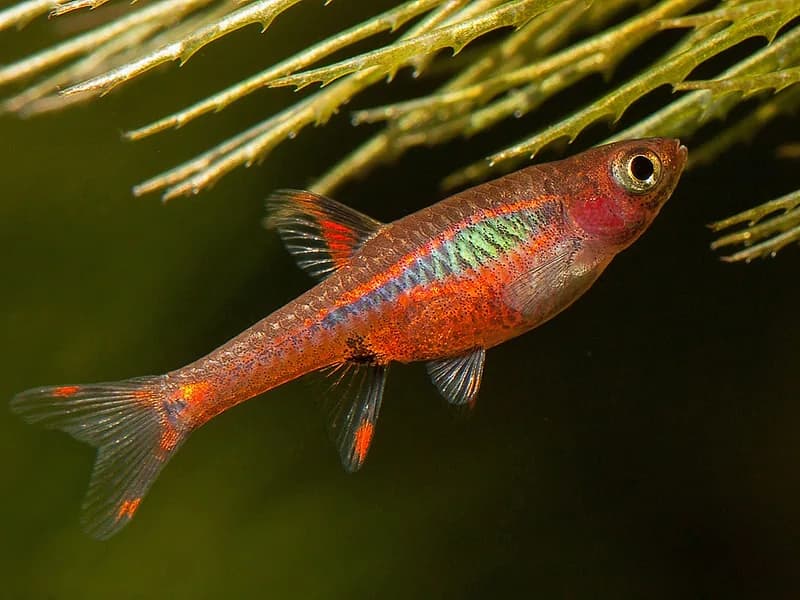 FishChili RasboraBoraras brigittae | 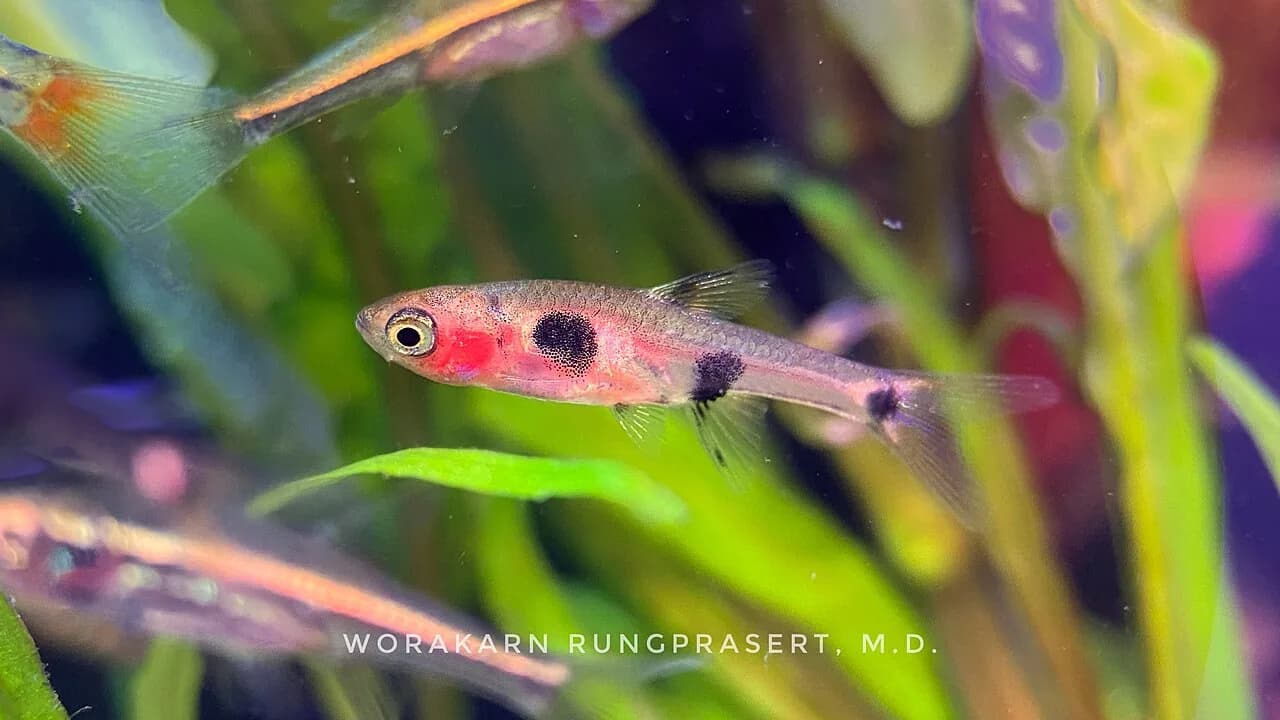 FishDwarf RasboraBoraras maculatus |
|---|---|---|
| Category | Fish | Fish |
| Origin | Southwestern Borneo blackwater swamps | Malaysia, Sumatra, Borneo |
| Family | Cyprinidae | Cyprinidae |
| Temperature | 24–28 °C | 23–28 °C |
| pH | 4.0–6.5 | 5.0–7.0 |
| Hardness (dGH) | 1–4 | 1–8 |
| Flow rate | Still to Low | Very low |
| Min tank | 30 L | 30 L |
| Adult size | 1.7–2 cm | 1.5–2 cm |
| Difficulty | 3 / 5 | 3 / 5 |
| Lifespan | 3–4 yrs | 3–4 yrs |
| Diet | Micropredator | Omnivore |
| Water column | Mid to Top | Mid |
| Schooling | Yes | Yes |
| Plant safe | Yes | Yes |
| Shrimp safe | Yes (adults and adult shrimp) | Yes |
Frequently asked questions
Direct answers to the questions search engines and AI assistants surface most often about this species.
Can you keep Chili Rasbora and Dwarf Rasbora together?
Yes. Their temperature and pH ranges overlap around 24 to 28 °C and pH 5 to 6.5, so one set of water conditions keeps both comfortable. Match group sizes and cover the usual planted-tank basics and they share a tank fine.
Which is easier to keep, the Chili Rasbora or the Dwarf Rasbora?
They sit at the same care level, both middle-of-the-road, so neither is the obvious beginner pick. The decision is really about the look you're after.
Do Chili Rasbora and Dwarf Rasbora need the same water?
Close to it. Aim for 24 to 28 °C and pH 5 to 6.5 and you're in the shared sweet spot for both. Full ranges are in the table above.
What's the main difference between the Chili Rasbora and the Dwarf Rasbora?
It comes down to look, size and pace rather than one being flatly better. The table above lays the numbers out row by row.