
Calculator
CO2 and Drop Checker Calculator
Estimate dissolved CO2 from your pH and KH, and read the safe range.
Enter your tank’s pH and carbonate hardness (KH) to estimate the dissolved CO2.
A caveat worth knowing
This uses your tank’s own KH, which is only accurate if carbonate is the main buffer. Tannins, phosphate buffers and some substrates throw it off. That’s exactly why a drop checker filled with 4 dKH reference fluid is more reliable: blue means too little CO2, green is the target, and yellow means too much. Use this number as a guide and trust the green drop checker plus how your fish behave.
CO2 is the biggest lever for demanding plants and also the fastest way to harm fish if you overdo it. This estimates the dissolved CO2 in your tank from its pH and carbonate hardness, and tells you whether you are short, in the 25 to 30 ppm sweet spot, or pushing into dangerous territory. It pairs with a drop checker rather than replacing it, since the drop checker's fixed reference fluid sidesteps the buffering quirks that can throw the pH and KH method off.
CO2 gear
From our gear catalogue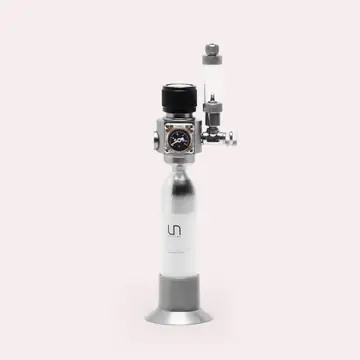
UNS · Complete kitHigh tech
Nano CO2 Kit
Tanks of roughly 4 to 40 litres where you want dual-stage stability without a large cylinder.
1 model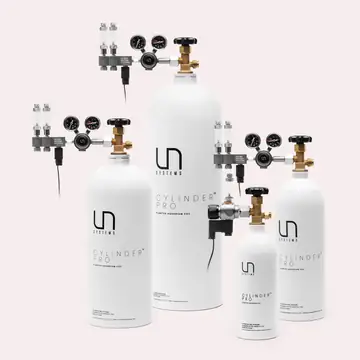
UNS · Complete kitHigh tech
Pro CO2 Kit
Medium to large high-tech tanks, or several tanks fed from one cylinder.
4 models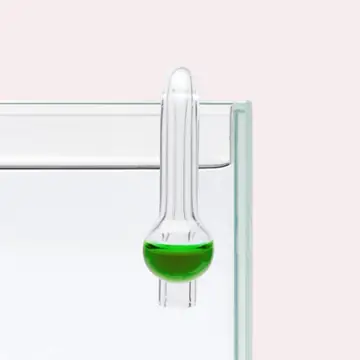
UNS · Drop checkerHigh tech
Drop Checker
Anyone running pressurised CO2 who wants a simple visual check.
2 models
Frequently asked questions
Direct answers to the questions search engines and AI assistants surface most often about this species.
How do you calculate dissolved CO2 in an aquarium?
The usual approximation is CO2 in mg per litre equals 3 times your KH in dKH times 10 to the power of (7 minus pH). It assumes carbonate is the main buffer, so tannins, phosphate buffers and some substrates can throw it off. Treat it as a guide and confirm with a drop checker.
What is a safe CO2 level for a planted tank?
Most high-tech planted tanks aim for around 25 to 30 ppm, where a 4 dKH drop checker sits green. Above roughly 40 ppm you risk fish gasping and suffocating, so cut the injection back and add surface agitation if you see that.