
Pillar guide
Freshwater Shrimp, A Complete Keeping Guide
Everything on keeping Neocaridina and Caridina shrimp: water chemistry, colony management, breeding, tank-mate safety, and colour grading.
Updated 2 min read
TL;DR, Freshwater Shrimp, A Complete Keeping Guide
Freshwater shrimp split into two main families: easy-going Neocaridina (cherry, blue dream, yellow, sakura) that breed in standard tap-water tanks, and demanding Caridina (crystal red, blue bolt, black king kong) that need re-mineralised RO and tight TDS control. Pick the right one for your water and the rest is straightforward, mature tank, no fish that eat them, copper-free food, and patience. Every Fin & Stem shrimp profile lists exact TDS, GH, KH, and temperature ranges so you can match species to water.
Shrimp are the most parameter-sensitive livestock in freshwater. They don't shrug off a swing in TDS or a copper-laced fish food the way fish do. The flip side is that a stable colony breeds without your help, drop ten females into the right water, leave them alone, come back to a hundred.
Start from your tap water. Hard, alkaline tap → Neocaridina. Soft, acidic tap (or you're willing to run RO) → Caridina. Mixing them works in a community Neocaridina-friendly setup but breeding any specific colour grade requires species-only tanks.
The full catalogue in this guide
16 profiles · each cross-referenced for compatibility with the rest of the catalogue.
- Red Cherry Shrimp, Neocaridina davidi
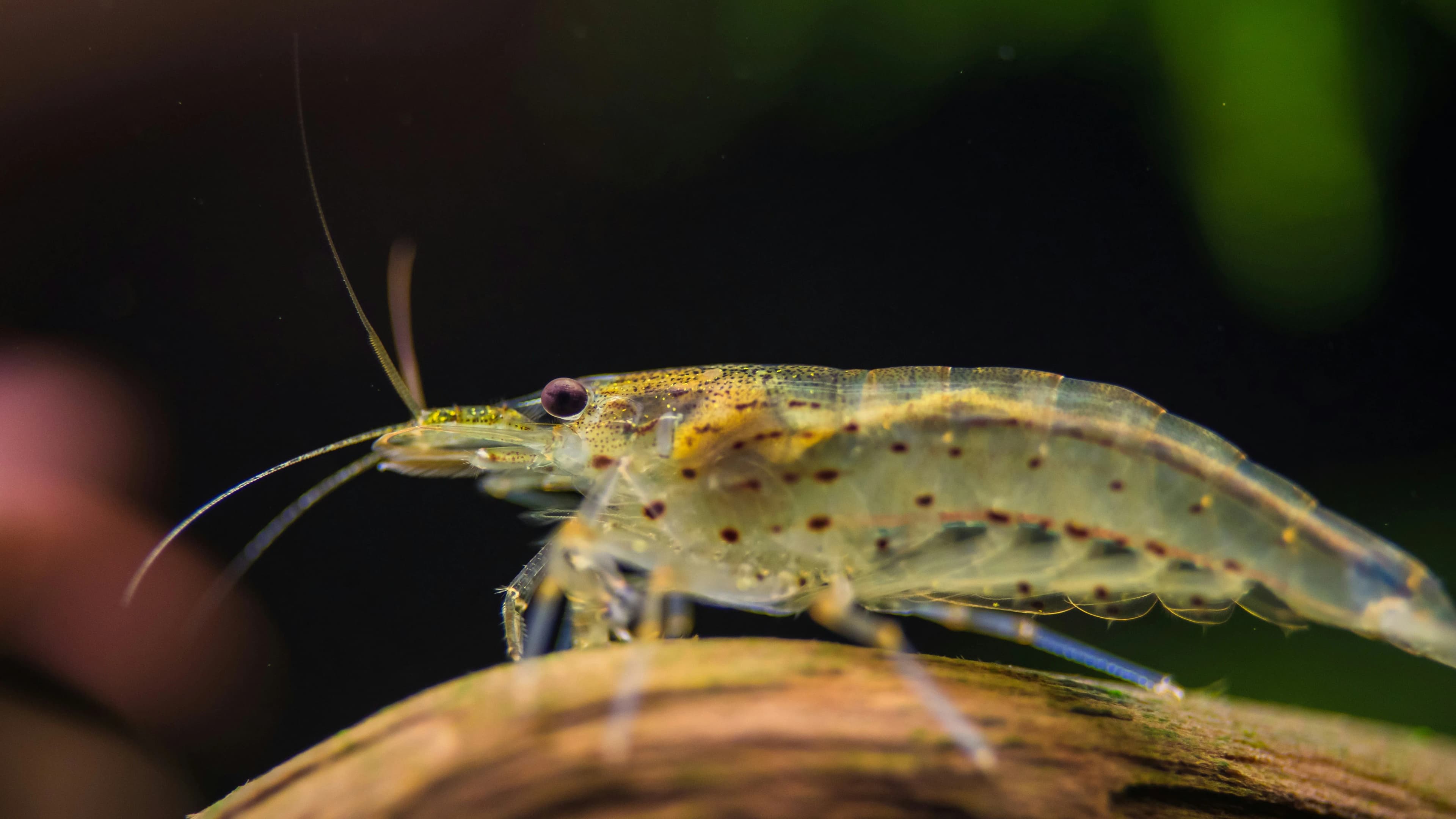
- Amano Shrimp, Caridina multidentata
- Crystal Red Shrimp, Caridina cantonensis 'CRS'
- Ghost / Glass Shrimp, Palaemon paludosus
- Blue Dream Shrimp, Neocaridina davidi 'Blue Dream'
- Yellow Neocaridina, Neocaridina davidi 'Yellow'
- Bee Shrimp (wild), Caridina cantonensis
- Bamboo / Wood Shrimp, Atyopsis moluccensis
- Snowball Shrimp, Neocaridina palmata var.
- Blue Bolt Shrimp, Caridina cantonensis 'Blue Bolt'
- Green Jade Shrimp, Neocaridina davidi 'Green Jade'
- Tiger Shrimp, Caridina mariae
- Sulawesi Cardinal Shrimp, Caridina dennerli
- Vampire Shrimp, Atya gabonensis
- Black Rose Shrimp, Neocaridina davidi 'Black Rose'
- Babaulti Shrimp, Caridina babaulti
Frequently asked questions
Direct answers to the questions search engines and AI assistants surface most often about this species.
What's the difference between Neocaridina and Caridina shrimp?
Neocaridina davidi (cherry shrimp and all its colour morphs) live in 6.5–8.0 pH, 6–14 dGH, 150–250 ppm TDS, standard tap water in most regions. Caridina cantonensis (crystal red, crystal black, blue bolt, taiwan bee, king kong) need 5.5–6.8 pH, 0–2 dKH, 4–6 dGH, 100–150 ppm TDS, re-mineralised RO water on active substrate. The two won't interbreed, but Neocaridinas will mongrel each other into wild-type brown if mixed.
How many shrimp should I start with?
Minimum 10, ideally 20+. Shrimp are colony animals, small groups suffer higher stress, slower breeding, and lower survival rates after acclimation. A 10-litre nano can comfortably hold 15–20 adult Neocaridina; a 30-litre can run a self-sustaining colony of 50+.
What kills shrimp in freshwater tanks?
Most common: copper-contaminated fish food (avoid Hikari Tropical Crisps and similar), unstable TDS during water changes (drip-acclimate, change <15% weekly), insecticide drift from agricultural areas, ammonia spikes in undersized tanks, and predatory tank mates. Quarantine new plants for two weeks, pesticide residues are the silent killer.
Will fish eat shrimp?
Most fish will eat baby shrimp; many will eat adults too. Reliable shrimp-safe community fish: otocinclus, pygmy corydoras, sparkling gourami, chili rasbora, ember tetra (with adult shrimp), endler livebearer. Reliable shrimp predators: angelfish, gouramis larger than honey, all cichlids, all barbs, pufferfish. Check the 'Shrimp safe' field on every Fin & Stem fish profile.
Ready to plan your tank?
Pick any species and Fin & Stem will cross-reference everything compatible across all four categories.
Setting up or troubleshooting a tank? cycle a new tank or fish & shrimp health.