
List article
Low-Light Aquarium Plants That Don't Need CO2
Six aquarium plants that thrive without CO2 in a low-tech tank. What works, what to avoid, plus a complete starter setup for a 60 litre tank.
Updated 8 min read
Part of our complete planted-aquarium guide.
The short answer
A planted aquarium without CO2 injection (a "low-tech" or "Walstad-style" tank) works beautifully with the right plants. The selection rules: rhizome epiphytes (Anubias, Java Fern, Bucephalandra), rosette plants (Cryptocoryne species), and hardy stem plants (Hygrophila polysperma, Rotala) that adapt to whatever conditions arrive. Demanding carpet plants like Hemianthus callitrichoides do not belong; they melt without CO2. Red colour-line stems do not belong either; they stay green without strong light and pressurised CO2. The trade-off is growth speed, not survival. A low-tech tank trims monthly rather than weekly and reaches "filled in" at six months rather than six weeks. Lighting target: 30 PAR at substrate for six to eight hours per day. Substrate: any inert sand or gravel with root tabs for the rosette plants.
What "low light, no CO2" actually means
The term gets used loosely. Two technical definitions matter.
Low light in aquarium terms means a photosynthetic photon flux density (PAR) of roughly 15 to 30 micromoles per square metre per second at the substrate. PAR is the measurement that matters for plant growth, not lumens or watts. A modern LED nano fixture (e.g. Chihiros C-series, Twinstar S-line, NICREW SkyLED) on a 30 to 60 litre tank delivers roughly low-medium PAR.
No CO2 means no pressurised CO2 system. The tank still has dissolved CO2 from atmospheric exchange and from fish respiration; just not the elevated 25 to 35 ppm that CO2 injection provides.
In this combination, plants photosynthesise slowly. They cannot match the growth speed of a high-tech tank no matter what is done. But plants that evolved in low-flow, dim, shaded environments (which is most popular aquarium species) do not need elevated CO2. They grow at their natural pace.
The trade-off is exactly that: time. A high-tech tank fills in over six weeks. A low-tech tank with the same plants takes six months. Both end up with similar density. The high-tech tank requires weekly trimming for the next two years; the low-tech tank requires monthly trimming.
The top six plants for low-tech tanks
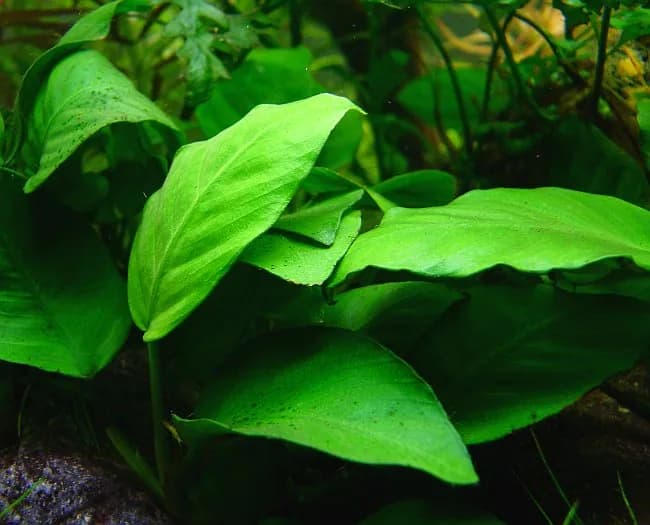
1. Anubias barteri nana
Anubias Barteri Nana
Anubias barteri var. nana
West Africa (Cameroon)
The most beginner-friendly plant in the catalogue. Anubias barteri var. nana is a rhizome epiphyte from West African streams. It attaches to wood or stone with cyanoacrylate gel, lives off nutrients in the water column, and grows so slowly that a single specimen needs trimming maybe once a year. Tolerates almost any light from very dim to medium, any temperature 22 to 28 degrees C, any pH 6 to 7.5. The only way to kill it is to bury the rhizome in substrate, which causes rot.
Use case: midground hardscape accent. Placement at a 30-degree angle on driftwood so the leaves catch the light.
2. Java Fern
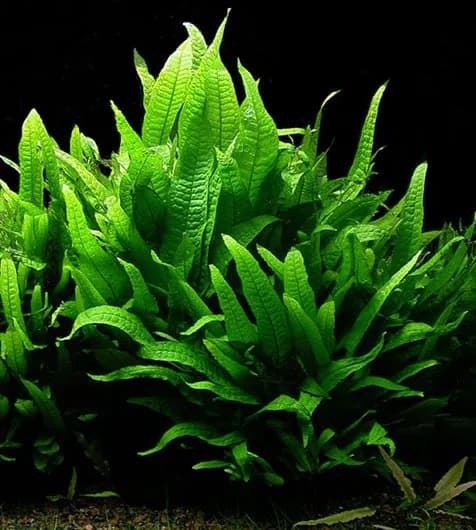
Java Fern
Microsorum pteropus
Southeast Asia
The other classic rhizome epiphyte. Microsorum pteropus tolerates the same parameter range as Anubias and attaches the same way. Java Fern grows faster than Anubias and produces daughter plants on its leaf tips that can be snapped off and attached elsewhere. Several cultivars exist (Windelov with lacy split tips, Trident with three-pronged leaves, Narrow Leaf) all with identical care.
Use case: midground to background hardscape accent. The species reaches 25 to 35cm and works best on tall driftwood pieces.
3. Cryptocoryne wendtii
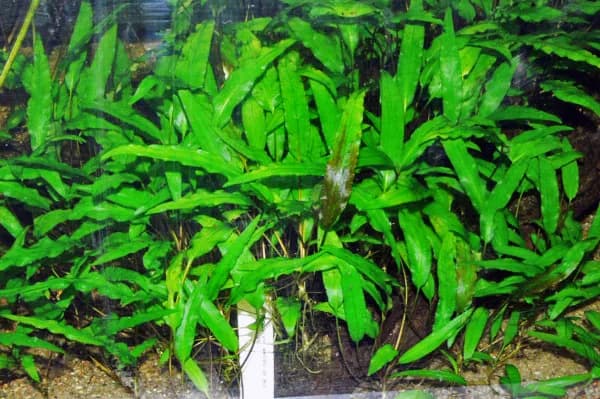
Cryptocoryne Wendtii
Cryptocoryne wendtii
Sri Lanka
The substrate plant. Cryptocoryne wendtii sends a rosette of leaves up from a buried crown in nutrient-rich substrate. It is famous for the "crypt melt" that happens when first planted: the leaves dissolve completely over two to three weeks as the plant adjusts to the tank, then regrow stronger from the root mass. The plant should stay put during melt, not get pulled.
Use case: midground filler around hardscape. Multiple cultivars exist (Green, Bronze, Tropica, Mi Oya, Red); the green and bronze types are most low-tech tolerant.
4. Vallisneria spiralis
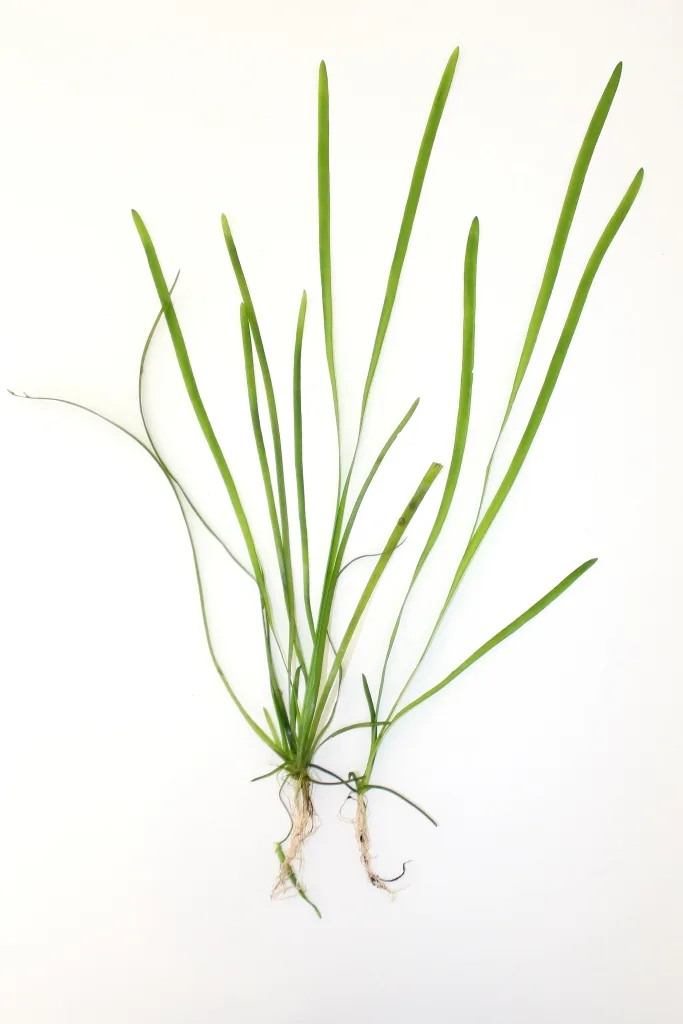
Vallisneria Spiralis
Vallisneria spiralis
Europe, Asia, Africa
The background plant for jungle-style scapes. Vallisneria spiralis is a runner-spreading rosette that sends out long curving ribbons of green leaves from a continuously expanding root system. In a low-tech tank, leaves reach 40 to 80cm long; the species was naturally selected for fast-flowing rivers where it streams horizontally with the current.
One specific warning: Vallisneria is killed by liquid carbon (Easy Carbo, Excel, glutaraldehyde-based products). A tank that doses any of these should not contain Vallisneria.
Use case: rear background wall. Three to five crowns planted 8cm apart across the back of the tank will spread to fill in over three months.
5. Hygrophila polysperma
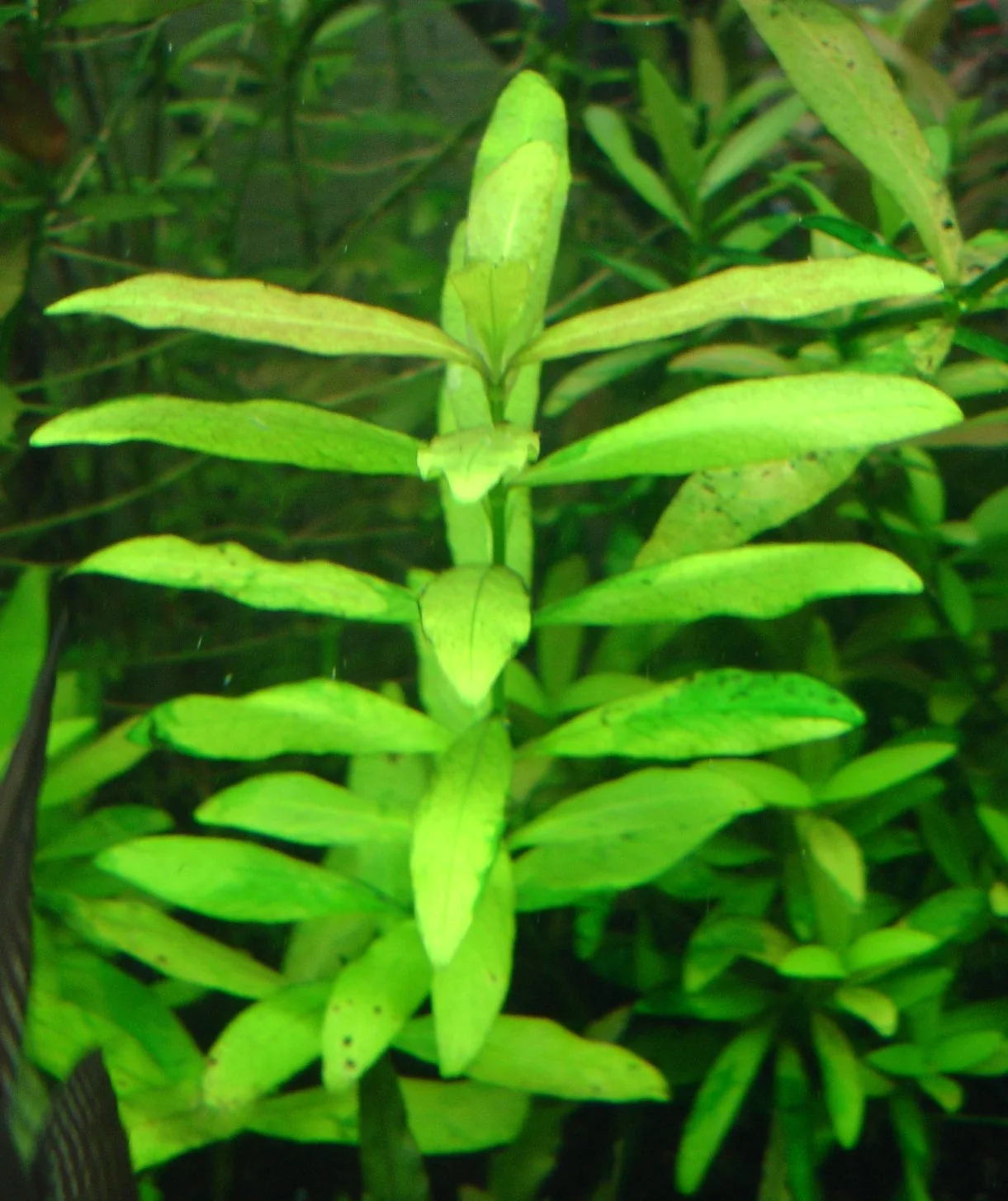
Dwarf Hygrophila
Hygrophila polysperma
India, Bangladesh, Bhutan
The fast-growth stem plant. Hygrophila polysperma is a true low-tech stem plant. It grows fast even at low light, tolerates pH 6 to 7.5 and a wide temperature range, and acts as a nutrient sponge that outcompetes algae in new tanks. The variegated cultivar "Sunset" has pink and cream new growth and is one of the prettier low-tech stems available.
One regional warning: Hygrophila polysperma is invasive in warmer parts of the United States and several southern US states have banned its sale. Local rules should be checked before sourcing.
Use case: background fill. Weekly trimming once established keeps it from reaching the surface and shading other plants.
6. Bucephalandra
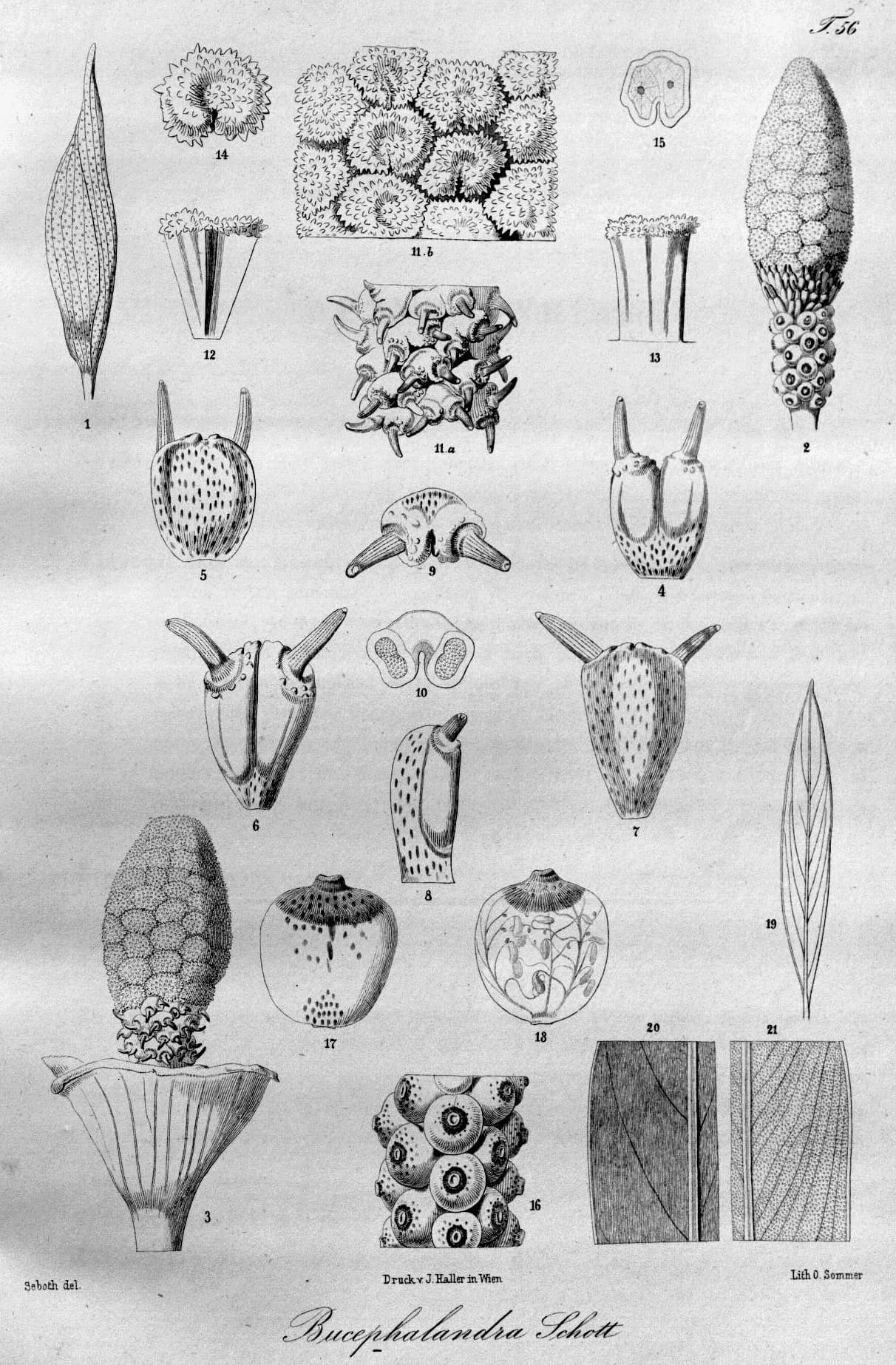
Bucephalandra (mixed)
Bucephalandra sp.
Borneo (rheophytic)
The premium rhizome plant. Bucephalandra is a rheophytic plant from Borneo with over 200 named cultivars. It attaches to stone (the genus prefers rock to wood) with cyanoacrylate, lives off the water column, and produces small white-and-purple flowers underwater. Growth is slow. Colour ranges from green to deep red depending on cultivar and light level.
Use case: ornamental hardscape accent. Individual specimens placed on focal stones where colour and detail will be seen up close.
The mosses worth growing
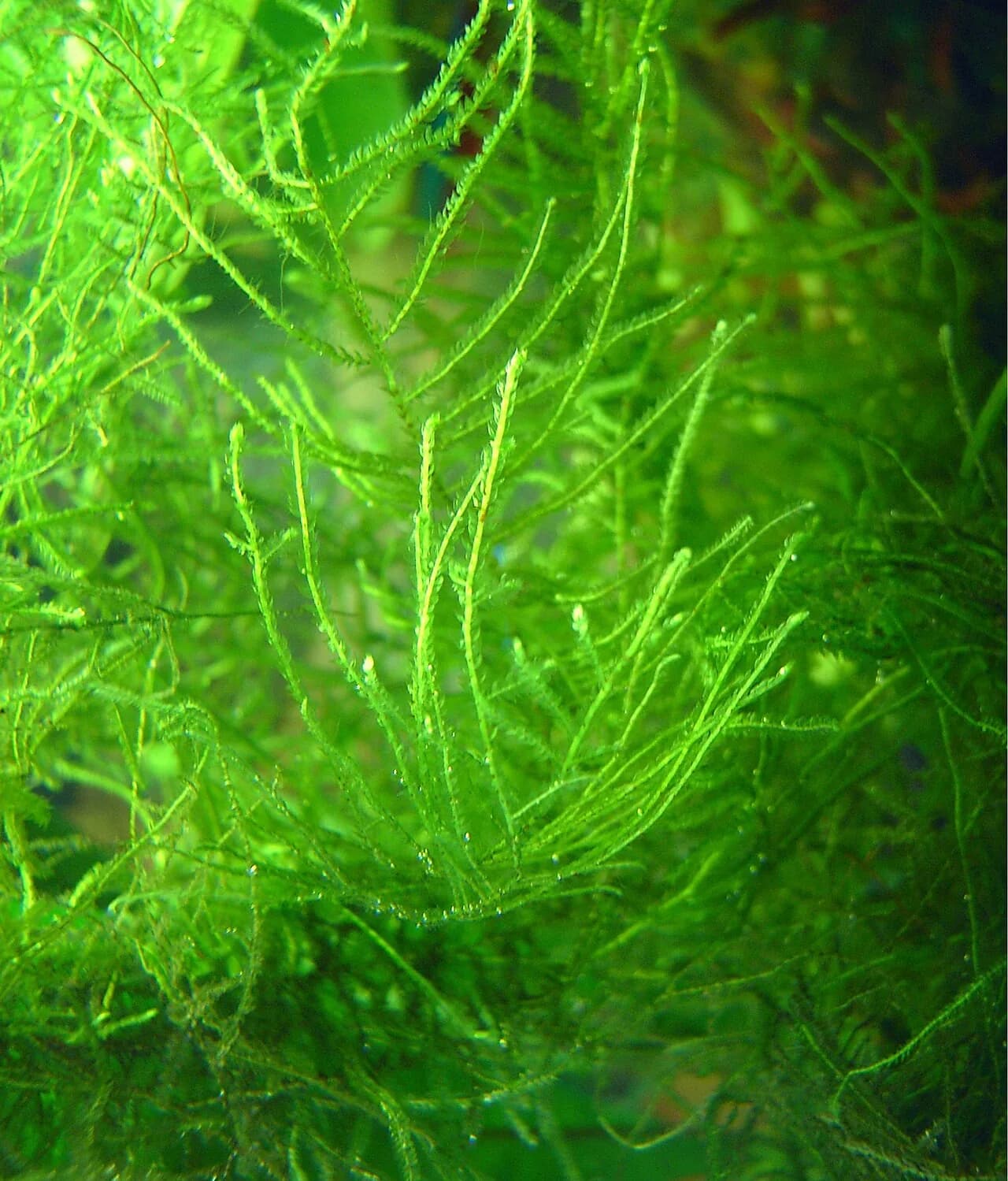
Java Moss
Taxiphyllum barbieri
Southeast Asia
Java Moss is the carpet substitute and shrimp nursery. Cheap, fast, tolerant of anything.
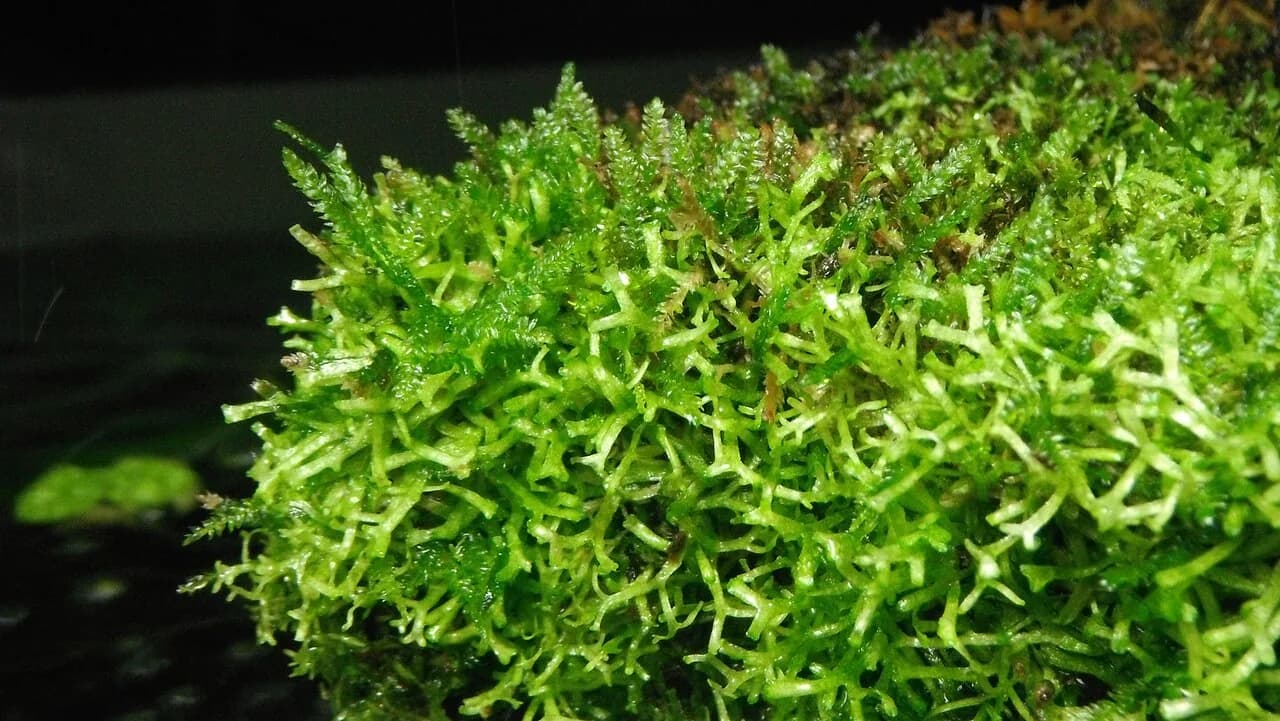
Christmas Moss
Vesicularia montagnei
Asia (tropical)
Christmas Moss is the ornamental moss. The triangular fan pattern only develops cleanly under medium light or with liquid carbon, so the result is less reliable than Java in a strictly low-tech tank. See Java Moss vs Christmas Moss for the full breakdown.
What not to attempt without CO2
Several beautiful plants need CO2 to survive long-term. They do not belong in a low-tech tank.
- Hemianthus callitrichoides "HC Cuba". The smallest carpet plant. Melts without CO2 within weeks.
- Monte Carlo (Micranthemum tweediei). Slightly more forgiving than HC but still requires medium light and ideally liquid carbon to carpet. Stays small and patchy in true low-tech.
- Rotala in red colour lines (R. 'H'ra', R. 'Colorata', R. macrandra). They grow but stay green. The intense red colour these species are bought for only develops under high light and stable CO2.
- Dwarf Hairgrass (Eleocharis parvula). Carpets slowly without CO2 and is prone to hair algae as it grows. Possible in low-tech but not recommended for a first tank.
- Most stem plants with red, pink, or orange colour. The colour pigments require strong light and CO2 to manifest. Without those, the plants survive but are visually disappointing.
Substrate options for a low-tech tank
Three substrate approaches all work.
Inert sand or gravel. Black sand (Imagitarium, CaribSea) or dark gravel. Cheap, easy, lasts forever. Pairs with root tabs for rosette plants. No buffering of pH.
Active aquasoil. ADA Amazonia, UNS Controsoil, Fluval Stratum. Provides nutrients to roots, lowers pH and KH (which most low-tech plants prefer). Lasts 12 to 24 months before nutrient capacity exhausts, then becomes inert. More expensive but better starting conditions.
Walstad-style soil capping. A 2cm layer of organic potting soil under a 4cm layer of sand. Maximum nutrient delivery to plant roots. Strong choice for an unfiltered or low-filtration tank. Cleanup if disturbed is messy.
For a first low-tech tank: inert dark sand with root tabs. Cheapest, easiest, looks great with green plants.
Lighting recommendations
An LED fixture rated for the tank size does the job. Modern nano LEDs are excellent and cheap.
- 30 to 40 litre tank: a single Chihiros C-series, Twinstar S-line, or NICREW SkyLED 14W.
- 60 litre tank: a Chihiros A-series, Fluval 3.0 Plant, or NICREW SkyLED 24W.
- 100 litre tank: a Fluval 3.0 or larger Chihiros, or two NICREW units.
A timer is essential: 6 hours per day to start, ramping to 8 hours over a month if no algae appears. 10 hours is the upper limit in a low-tech tank.
A complete low-tech 60 litre stocking
A standard low-tech starter setup, full plant and fish list.
Plants:
- 3 Anubias barteri nana attached to driftwood corner accent
- 1 Java Fern on a tall piece of driftwood (background)
- 5 Cryptocoryne wendtii (midground filler)
- 5 Vallisneria spiralis crowns along the back wall
- 1 cluster Hygrophila polysperma (right midground)
- 1 wad Java Moss attached to a low stone
Hardscape:
- 2 to 3 pieces spider wood, arranged off-centre
- Black sand substrate
- Indian almond leaves on the floor for tannins
Equipment:
- 60-litre rimless tank
- Chihiros A-series or equivalent LED
- Sponge filter or low-flow internal
- 50W heater
Stocking:
- 10 ember tetras (mid-water school)
- 6 pygmy corydoras (mid-bottom shoal)
- 15 cherry shrimp (cleanup crew)
For the full stocking guide with sample timeline and cost breakdown, see stocking a 60 litre community planted tank.
Plan the low-tech tank
The plants catalogue with low-light and no-CO2 filters applied returns every plant in the catalogue that fits a low-tech setup. The compatibility tool anchored to Java Fern returns the fish and shrimp that overlap with its parameter window.
Related reading
- Best fish for a 30 litre planted tank
- Java moss vs Christmas moss: which to choose
- Stocking a 60 litre community planted tank
- Can neon tetras live with cherry shrimp?
Sources
Frequently asked questions
Direct answers to the questions search engines and AI assistants surface most often about this species.
Can plants grow in an aquarium without CO2?
Yes. The plants in this article (Anubias, Java Fern, Cryptocoryne, Vallisneria, Hygrophila, Bucephalandra) all thrive without CO2 injection. They grow slower than CO2-injected tanks but reach the same final density, just over 6 months instead of 6 weeks.
What is the easiest aquarium plant for beginners?
Anubias barteri nana. Difficulty 1 out of 5. Attaches to wood or stone with glue, lives off the water column, tolerates almost any light and temperature, never needs trimming. A single specimen survives years of neglect.
Do low-tech tanks need root tabs?
Some plants need them, others do not. Rhizome plants (Anubias, Java Fern, Bucephalandra) live off the water column and ignore root tabs. Rosette plants (Cryptocoryne, Vallisneria) are heavy root feeders and benefit from a tab every four months. Stem plants vary by species.
How long should aquarium lights be on for low-tech plants?
Six to eight hours per day. Longer photoperiods invite algae blooms in tanks without CO2 to drive plant growth. Six hours is the safe floor; ramping up to eight works if the plants look pale. A timer keeps the schedule consistent.
Can a low-tech tank look as good as a high-tech one?
Yes, with different aesthetics. Low-tech tanks favour a jungle or natural look with broad-leaf plants and slower-growing species. High-tech tanks favour Dutch-style stem walls and red colour-line plants. Both can be beautiful; they look different.