
List article
Best Fish for a 30 Litre Planted Tank
A 30 litre planted tank has one fish slot, not several. Four top picks, why neon tetras do not belong, and three complete sample stockings.
Updated 6 min read
Part of our complete aquarium-fish guide.
The short answer
A 30 litre planted tank is a nano. The honest stocking math is one schooling species, kept in numbers, plus a shrimp colony. The four fish that fit best are the chili rasbora, ember tetra, celestial pearl danio, and pygmy corydoras. All four sit under 3cm as adults, have low bioloads, and display proper schooling behaviour in groups of eight to ten. Neon tetras do not belong here even though pet stores will sell them for a tank this size. They need a 60 litre minimum to show natural behaviour and the bioload sits at the upper end of acceptable. The plant side is easier: any low-light, no-CO2 plant works. Three sample stockings with full plant lists appear below.
Why 30 litres is one-school territory
The bioload math is straightforward. A 30 litre planted tank has roughly 25 litres of usable water after substrate and hardscape. The accepted stocking guideline for nano fish is about one centimetre of adult fish per litre of water in a planted tank, which gives a 25cm fish budget.
A school of 10 ember tetras at 2cm each consumes 20cm of that budget. Eight ember tetras instead leaves room for a small bottom group or a shrimp colony. A school of 10 neon tetras at 3.5cm each comes to 35cm, well over budget, plus the species needs more swimming space than 30 litres provides.
The footprint argument matters too. A standard 30 litre cube is around 30cm long. Schooling fish need length to swim. Neons in a short tank will reach the end wall and turn back constantly, which the species reads as a stress signal. Smaller fish are unbothered by the same dimensions.
The four top picks
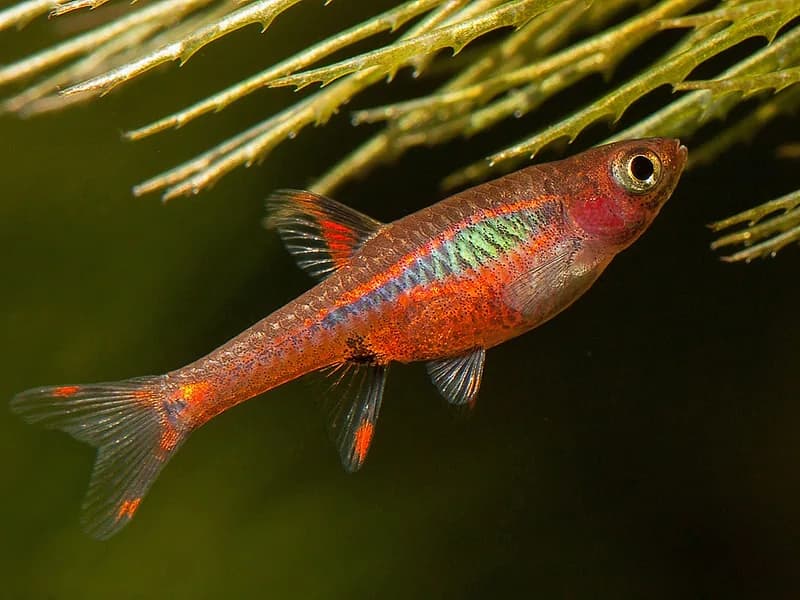
Chili rasbora (Boraras brigittae)
Chili Rasbora
Boraras brigittae
Southwestern Borneo blackwater swamps
The best species-appropriate match for a 30 litre planted tank. Chilis come from peat swamps in southwest Borneo and want soft, acidic, tannin-stained water. A nano tank planted with floating plants and dosed with catappa leaves is exactly their environment. A group of 10 to 15 sits mid-water, schools loosely, and pops a deep glowing red against dark substrate. The trade-off is parameter discipline. In a region with hard tap water, RO water or a different fish is the right call.
Ember tetra (Hyphessobrycon amandae)
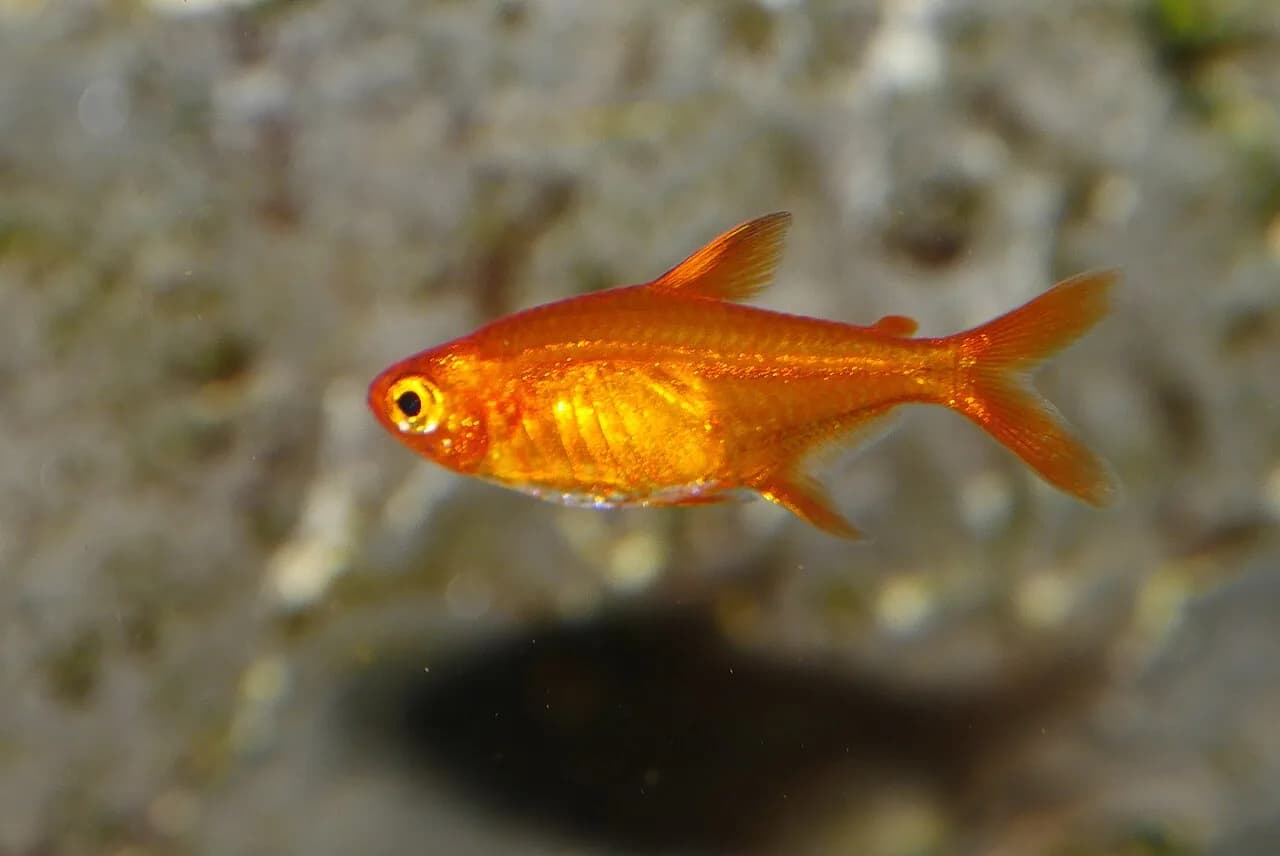
Ember Tetra
Hyphessobrycon amandae
Rio das Mortes basin, Brazil
The most forgiving option. Ember tetras tolerate a wide parameter range, ship well, and the fluorescent orange-red colour is visible across the room against green plants and dark wood. A group of 10 will school loosely in mid-water and breed casually in a mature tank without intervention. See how many ember tetras should you keep together for the schooling depth-of-detail.
Celestial pearl danio (Danio margaritatus)
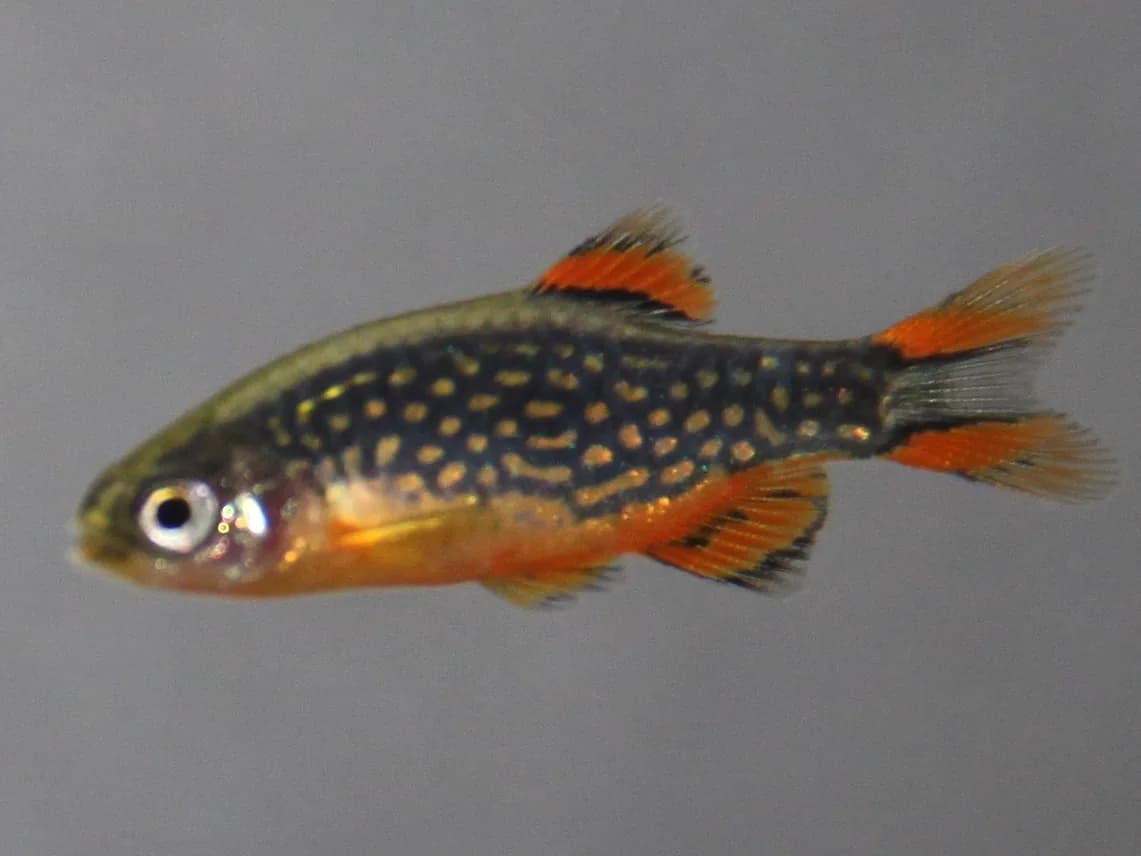
Celestial Pearl Danio
Danio margaritatus
Hopong area, Myanmar
The cool-water option. CPDs come from a small area of Myanmar's Shan State at altitude, in hard and slightly alkaline water. They want temperatures below 25 degrees C and pH 7 to 7.5, which is the opposite of the blackwater nano profile. CPDs are the right pick for hard tap water and a cool-running house. A group of six to eight in a well-planted nano shows stunning male display behaviour. Two females per male prevents the males from stressing each other.
Pygmy corydoras (Corydoras pygmaeus)
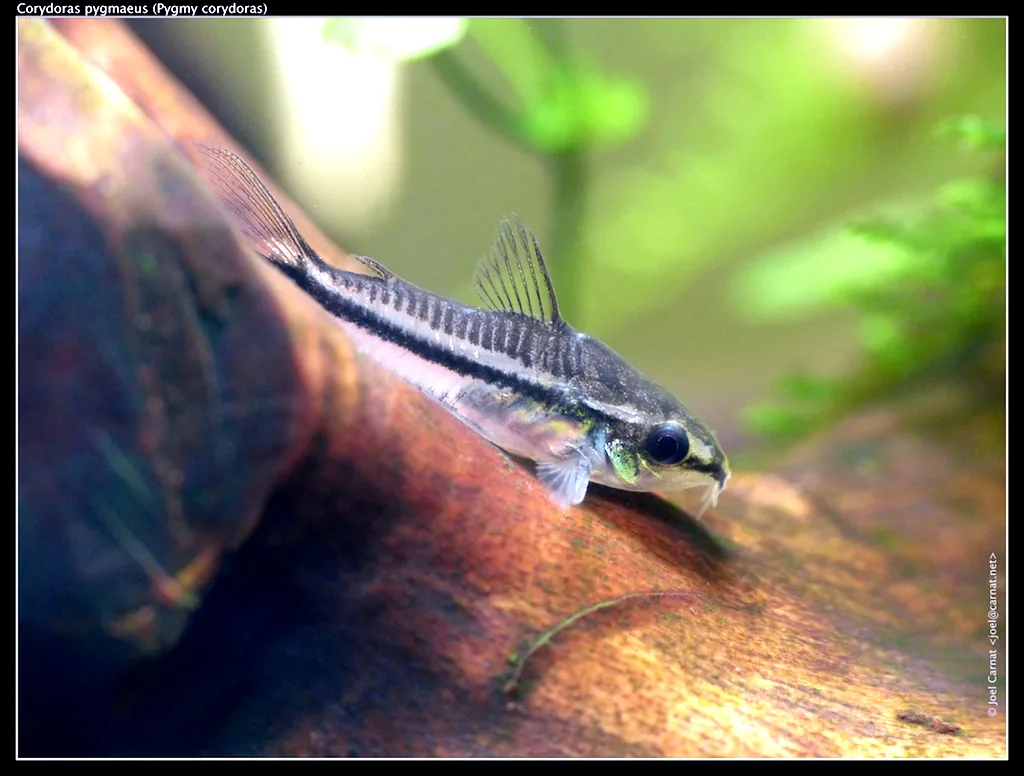
Pygmy Corydoras
Corydoras pygmaeus
Madeira River basin, Brazil
The unusual choice. Unlike most corys which stay glued to the substrate, Corydoras pygmaeus swims in mid-water shoals of six to eight. The behaviour is rare and pretty. They need fine sand substrate (gravel damages the barbels) and they ignore shrimp entirely. They tolerate the same parameters as ember tetras, which makes for a tempting two-species tank, except that mixing two schools in 30 litres usually means neither school is big enough. A single-species school of eight pygmy corys works as the only fish in the tank.
The shrimp partner
Every one of the four fish above tolerates a cherry shrimp colony in the same tank. The shrimplet predation rate varies by fish:
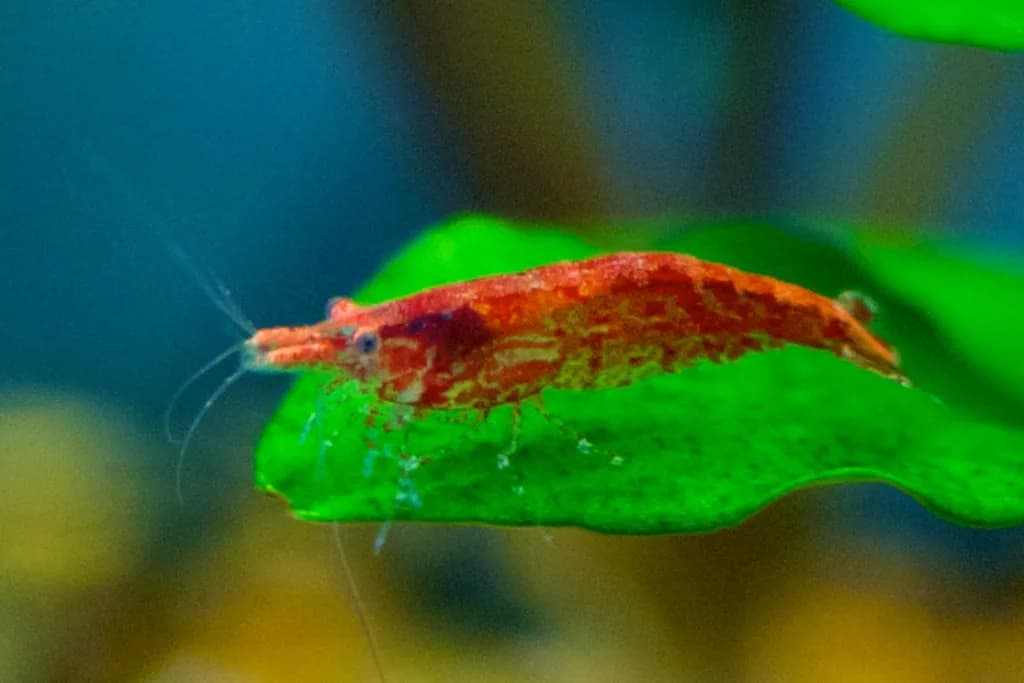
Red Cherry Shrimp
Neocaridina davidi
Taiwan (selectively bred)
- Chili rasbora: very low predation. They are too small to eat all but the smallest shrimplets.
- Ember tetra: low predation. Adults take occasional shrimplets but the colony grows.
- Celestial pearl danio: low-to-moderate predation. CPDs are slightly more predatory than the tetra species.
- Pygmy corydoras: essentially zero predation.
In all four cases, dense moss cover means the colony grows steadily. See can neon tetras live with cherry shrimp for the moss-coverage detail. A starter colony of 10 to 15 shrimp becomes 30+ in six months if the parameters are right.
Plant pairings for the nano
Three plants do all the work in a 30 litre tank without CO2.
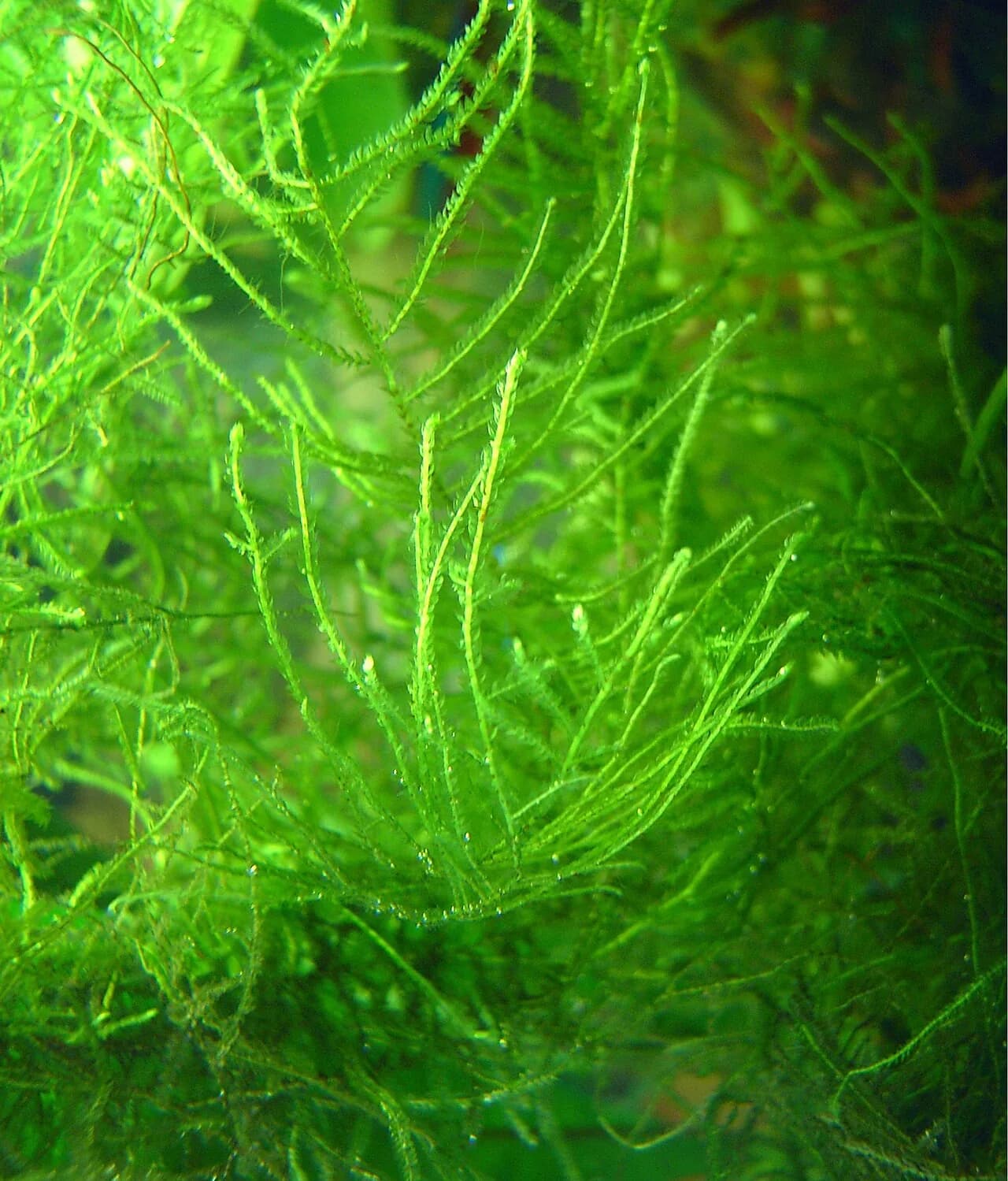
Java Moss
Taxiphyllum barbieri
Southeast Asia
Java moss is the carpet substitute, the shrimplet nursery, and the cheap insurance plant. A portion tied to a piece of driftwood and left to cover one corner of the tank will trap biofilm, hide shrimplets, and give the fish school somewhere to dart through.
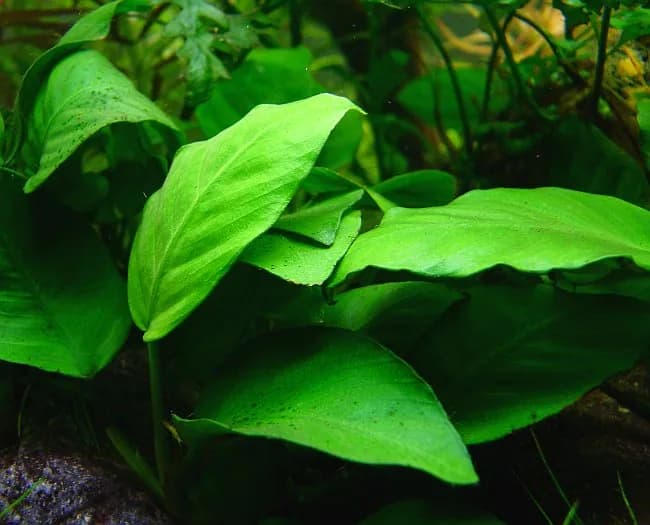
Anubias Barteri Nana
Anubias barteri var. nana
West Africa (Cameroon)
Anubias nana is the hardscape accent. The rhizome glues to a piece of wood or stone with cyanoacrylate; the plant lives off the water column and the slow growth means it almost never needs trimming. Placement at an angle catches the light.
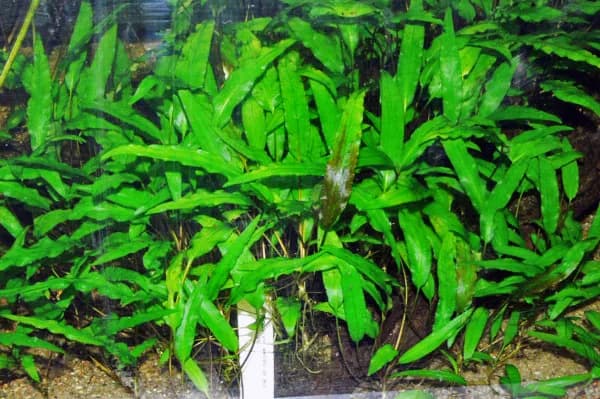
Cryptocoryne Wendtii
Cryptocoryne wendtii
Sri Lanka
Cryptocoryne wendtii is the substrate plant. It fills the midground around the hardscape. It melts the first two weeks after planting (a famous quirk of the genus) and regrows stronger from the roots. A root tab pushed next to it every four months produces best colour.
For a full list of low-tech plants that work in this tank, see low-light aquarium plants that don't need CO2.
What not to put in a 30 litre
- Neon tetras and cardinal tetras. Both species need 60 litres minimum to school properly. They are sold for smaller tanks all the time, but the fish are stressed in that footprint.
- Bettas in a community. A male betta in 30 litres is fine alone. The moment tetras or shrimp arrive, the betta either harasses them or gets fin-nipped. The combination almost never works as billed.
- Dwarf gouramis. A 30 litre tank is too small for a dwarf gourami's territorial range. They become listless or aggressive.
- Goldfish. Always. A single fancy goldfish needs at least 75 litres. A common goldfish needs a pond.
- Otocinclus. Six or more otos in 30 litres is technically possible but they need a heavily mature biofilm-rich tank, which a 30 litre rarely achieves. Skip otos at this volume.
Sample stockings
Three concrete builds. Costs are rough USD estimates from typical retail.
The blackwater nano
Goal: a soft-water Southeast Asian biotope.
- 12 chili rasboras (~$50)
- 15 cherry shrimp (~$45)
- Plants: Java moss, Anubias nana, Cryptocoryne wendtii (~$25)
- Hardscape: spider wood, dark sand, three catappa leaves (~$25)
Total stocking cost: ~$145
The colour-pop community
Goal: high visibility, easy to maintain.
- 10 ember tetras (~$35)
- 15 cherry shrimp (~$45)
- Plants: Java moss, Anubias nana, Cryptocoryne wendtii, a single Hygrophila polysperma stem cluster (~$30)
- Hardscape: dark stones, dark sand (~$20)
Total stocking cost: ~$130
The cool-water Myanmar
Goal: an unusual species in a different parameter profile.
- 8 celestial pearl danios (~$60)
- 15 cherry shrimp (~$45)
- Plants: Java moss, Anubias nana, Vallisneria spiralis for the back (~$30)
- Hardscape: light substrate, slate stones (~$20)
Total stocking cost: ~$155
Plan your own with the planner
The planner tool takes a tank volume of 30 litres and surfaces stocking density warnings plus every species in the catalogue that fits. The compatibility tool anchored to any of the four picks above shows plant, shrimp, and moss matches.
Related reading
- Can neon tetras live with cherry shrimp?
- Neon tetra vs cardinal tetra: the real differences
- How many ember tetras should you keep together?
- Low-light aquarium plants that don't need CO2
- Java moss vs Christmas moss: which to choose
Sources
Frequently asked questions
Direct answers to the questions search engines and AI assistants surface most often about this species.
Can neon tetras go in a 30 litre tank?
Not properly. Neons need a minimum of 60 litres to school the way they should. Six fit in 30 litres, but they will not show the natural shoaling behaviour and the bioload sits on the edge. A smaller schooling species is the better choice.
How many ember tetras in a 30 litre tank?
10 ember tetras work well in 30 litres. They are 2cm adults, low bioload, and dense planting absorbs the extra waste. See How many ember tetras should you keep together for the schooling math.
Is it possible to mix two species of nano fish in 30 litres?
Generally no. 30 litres has one school slot. Adding a second species means both schools end up too small (typically four to five fish each) to display natural behaviour. The exception is a bottom species like three pygmy corydoras alongside a top-water school, but the trade-off is reduced swimming volume.
Will cherry shrimp breed with ember tetras?
Yes, with thick moss cover. Adult cherries are too big for ember tetras to eat. Shrimplets will get picked off without enough refuge. A wad of Java Moss the size of a tennis ball is the minimum for a breeding colony alongside fish.
Is CO2 required for a 30 litre planted tank?
No. The plant list in this article (Java Moss, Anubias, Cryptocoryne Wendtii) thrives without CO2 injection. A faster-growing or red-stem-heavy scape later may benefit from a small pressurised CO2 system, but it is not required to start.