
Tank setup
Stocking a 60 Litre Community Planted Tank
A complete stocking guide for a 60 litre planted community tank. Three species plus shrimp, full plant list, equipment, parameters, and 6-week timeline.
Updated 9 min read
Part of our complete aquarium-fish guide.
The short answer
A 60 litre tank is the sweet spot where nano keeping ends and real community aquaristics begin. Small enough to maintain in 20 minutes a week, large enough to keep multiple species without bioload stress. The classic three-layer community: a top-water schooling species (10 ember tetras or harlequin rasboras), a centrepiece group like 3 sparkling gouramis or 6 otocinclus, a bottom-dwelling cory school (6 pygmy corydoras), and a cherry shrimp colony (10 to 15 to start). Total of around 30 fish plus shrimp in 60 litres. Heavy planting with Anubias and Java Fern on hardscape, Cryptocoryne wendtii in the midground, and Vallisneria for the back wall. Soft-to-moderate water at pH 6.5 to 7.5, dGH 4 to 10, 24 to 26 degrees C. Sponge filter or gentle canister. Total setup cost around $200 to $350.
Why 60 litres is the sweet spot
Bioload math at 60 litres opens up a real community without overstocking risk. The accepted guideline of roughly 1cm of adult fish per litre of usable water gives a fish budget of around 40 to 50cm in a planted tank (which buffers more than a bare tank). A school of 10 ember tetras at 2cm uses 20cm. Three sparkling gouramis at 4cm each add 12cm, and six pygmy corys at 2.5cm each add 15cm, totalling 47cm. Comfortable.
Maintenance time at 60 litres is manageable. A weekly 25-percent water change is about 15 litres, a single 20-litre bucket. Glass cleaning, filter rinse, and plant trim adds maybe 20 minutes a week. Below 30 litres, the maintenance scales down further but the stocking flexibility drops too far. Above 100 litres, water changes become a chore and equipment costs climb. 60 litres balances both sides.
The footprint is also wide enough for proper schooling. A standard 60 litre tank is around 60cm long, double the typical 30 litre cube. Schooling fish need that horizontal swimming room.
The three-layer stocking model
Aquarium stocking works best in terms of water-column layers. Different species occupy different vertical bands, and a community tank with one species per band reads as a complete ecosystem rather than a random collection of fish.
Top: schooling species that hover mid-to-upper water. Tetras and rasboras.
Mid: centrepiece species or middle-layer shoals. Gouramis, dwarf cichlids, or species that occupy the middle band consistently.
Bottom: substrate-grazing or bottom-shoaling species. Corydoras, otocinclus, or loaches.
Invertebrate: shrimp and snails that clean the whole tank.
A balanced community has one species filling each layer. Overcrowding a layer makes the tank feel chaotic and increases inter-species stress.
A recommended community
The stocking that consistently works in a 60 litre planted tank.
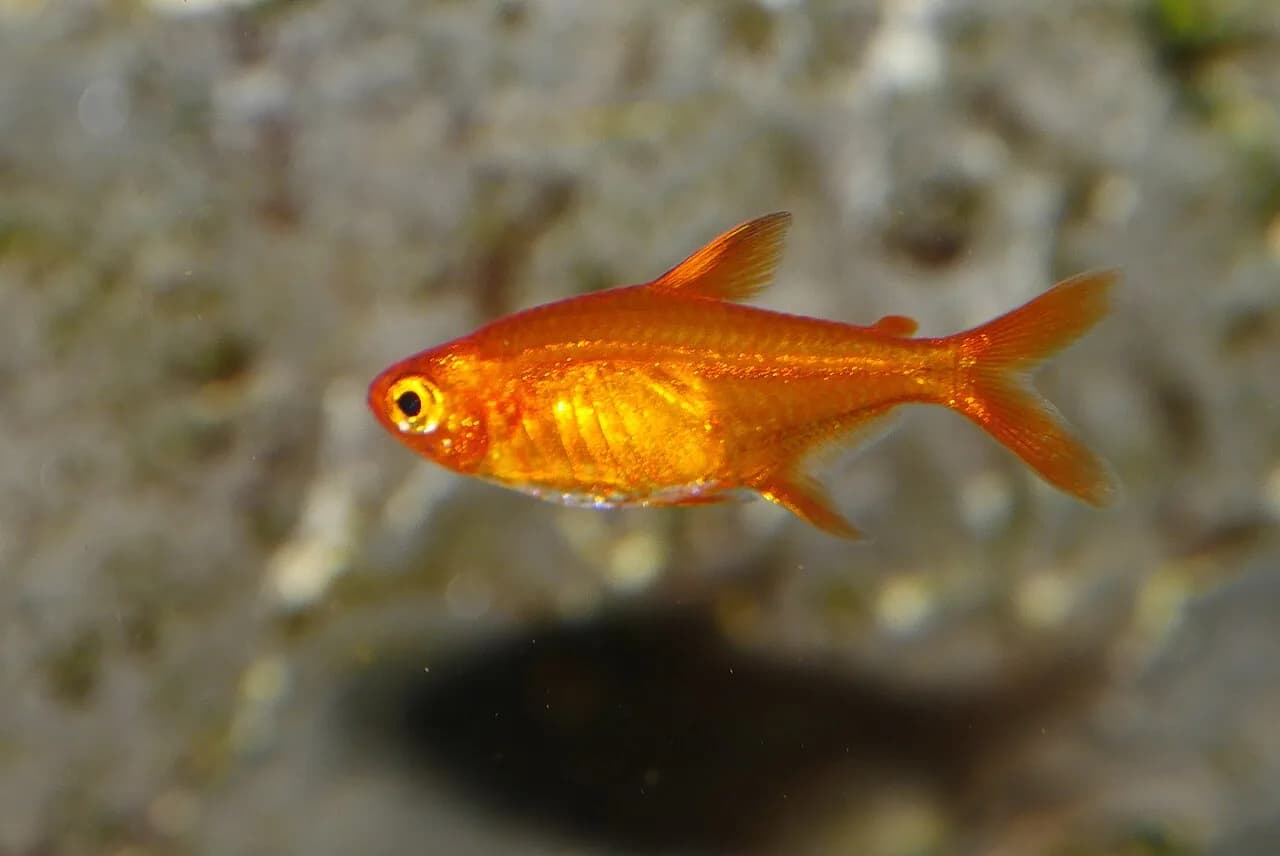
Top: 10 ember tetras
Ember Tetra
Hyphessobrycon amandae
Rio das Mortes basin, Brazil
Ember tetras are the most forgiving schooling species for this tank size. They sit in mid-water and tolerate the same parameter window the other species in this stocking want. See how many ember tetras should you keep together for why 10 is the right count.
Alternative: 8 harlequin rasboras.
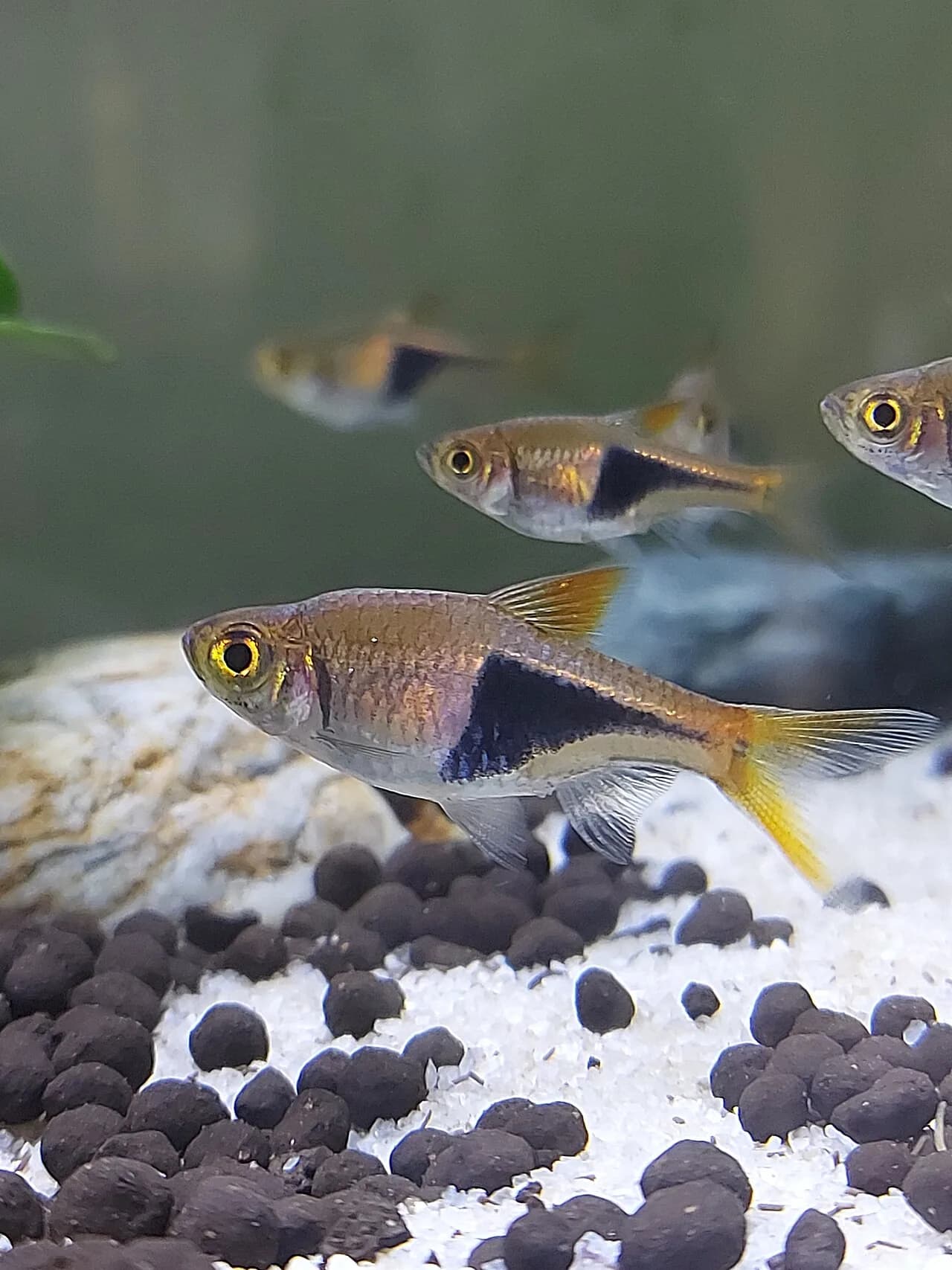
Harlequin Rasbora
Trigonostigma heteromorpha
Thailand, Malaysia, Sumatra
Slightly larger than embers (4 to 5cm) and equally beginner-friendly. The distinctive black wedge marking is iconic. Rasboras are the right pick when a slightly bigger fish in the top layer is preferred.
Mid: 3 sparkling gouramis
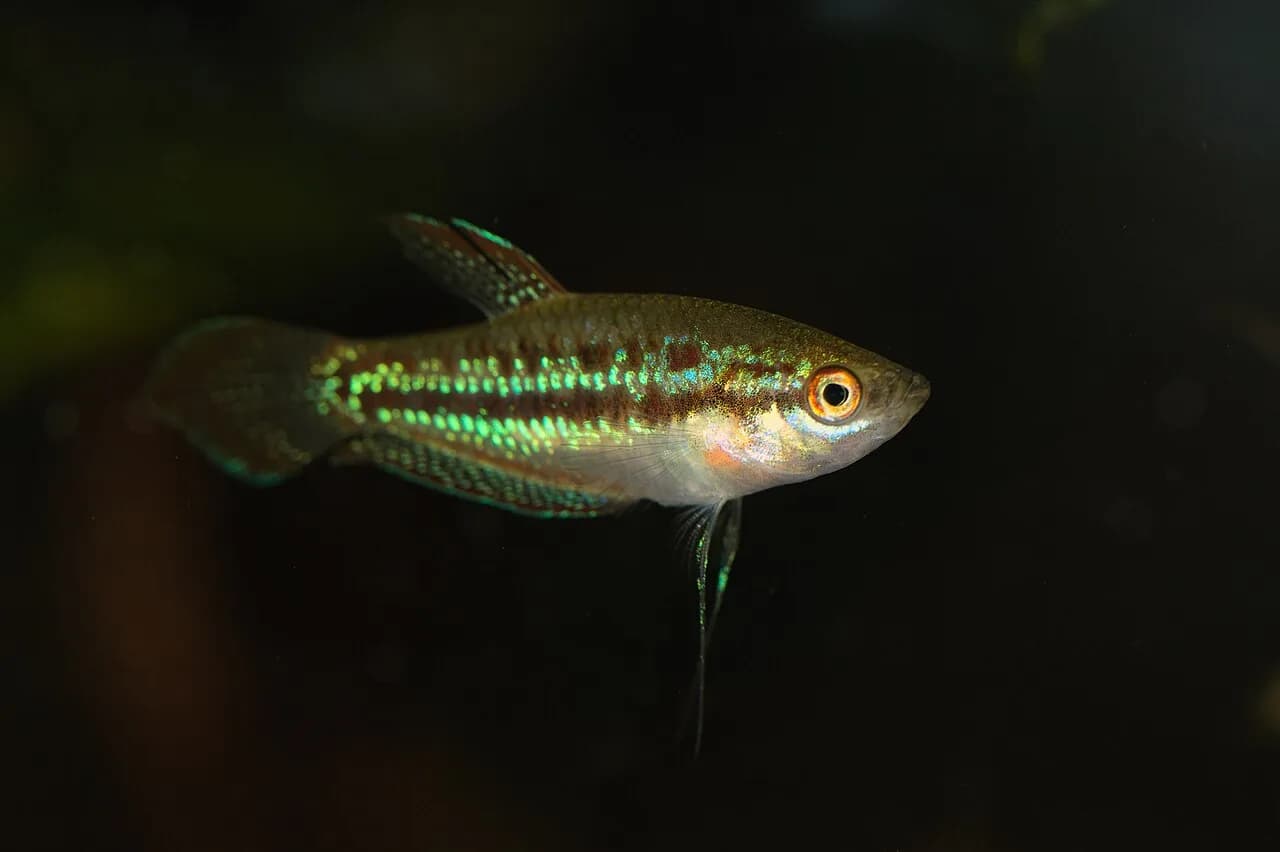
Sparkling Gourami
Trichopsis pumila
Southeast Asia (Mekong, Chao Phraya)
A trio of sparkling gouramis (one male, two females) makes a perfect centrepiece. They are labyrinth fish so they need surface access. They croak audibly during courtship displays (the sound is from the swim bladder, not the mouth). Calm, slow-moving, and visually striking with their metallic blue scales.
Alternative: 6 otocinclus.
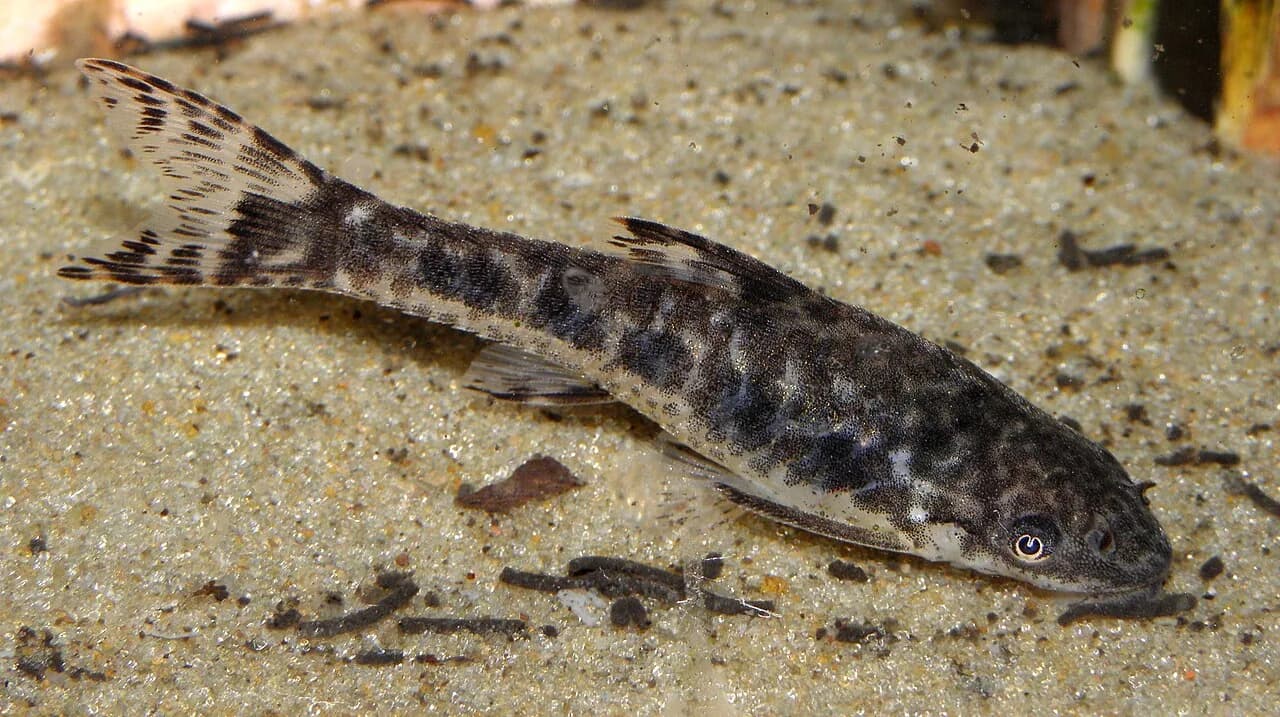
Otocinclus (Common)
Otocinclus vittatus
Northern and central South America
Otos pull double duty as algae grazers and mid-layer occupants. The trade-off is that they need a mature tank with established biofilm before they can survive (see do otocinclus really eat algae). New tanks should skip otos; revisit at month 4 or 5.
Bottom: 6 pygmy corydoras
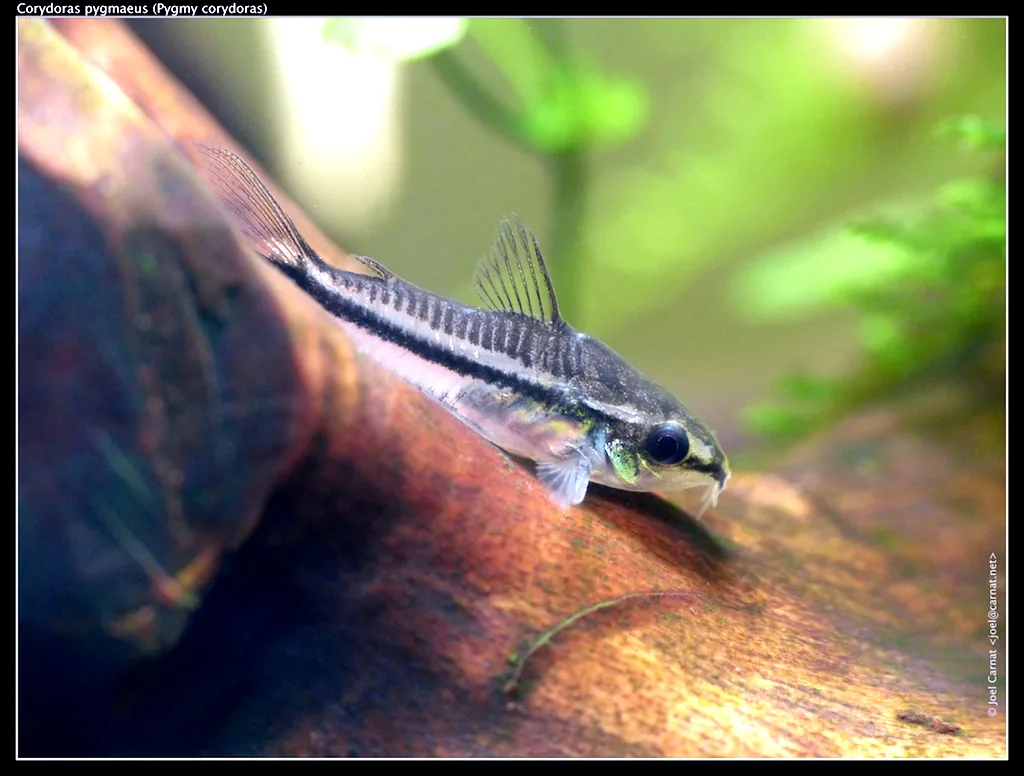
Pygmy Corydoras
Corydoras pygmaeus
Madeira River basin, Brazil
Unlike most corys, pygmy corys swim in mid-water shoals when given numbers. They need fine sand substrate (gravel damages barbels). A school of six occupies the bottom third of the tank and provides constant gentle motion at substrate level.
Cleanup: 10 to 15 cherry shrimp
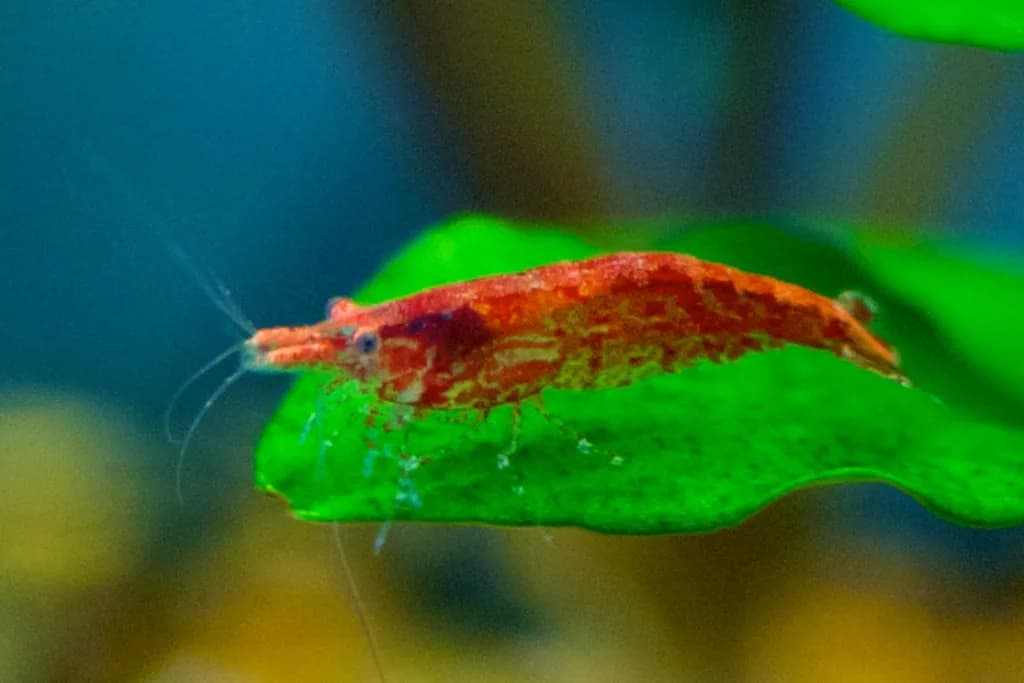
Red Cherry Shrimp
Neocaridina davidi
Taiwan (selectively bred)
10 to 15 Red Cherry Shrimp is the right starting count. In six months the colony grows to 30+ in a well-set-up planted tank. Cherries graze biofilm off plants and hardscape, and the colour pops against green plants. See Neocaridina vs Caridina for the genus comparison and other colour-line options.
The plant scape
Five plant species cover all the layers in a 60 litre tank.
Background: Vallisneria spiralis
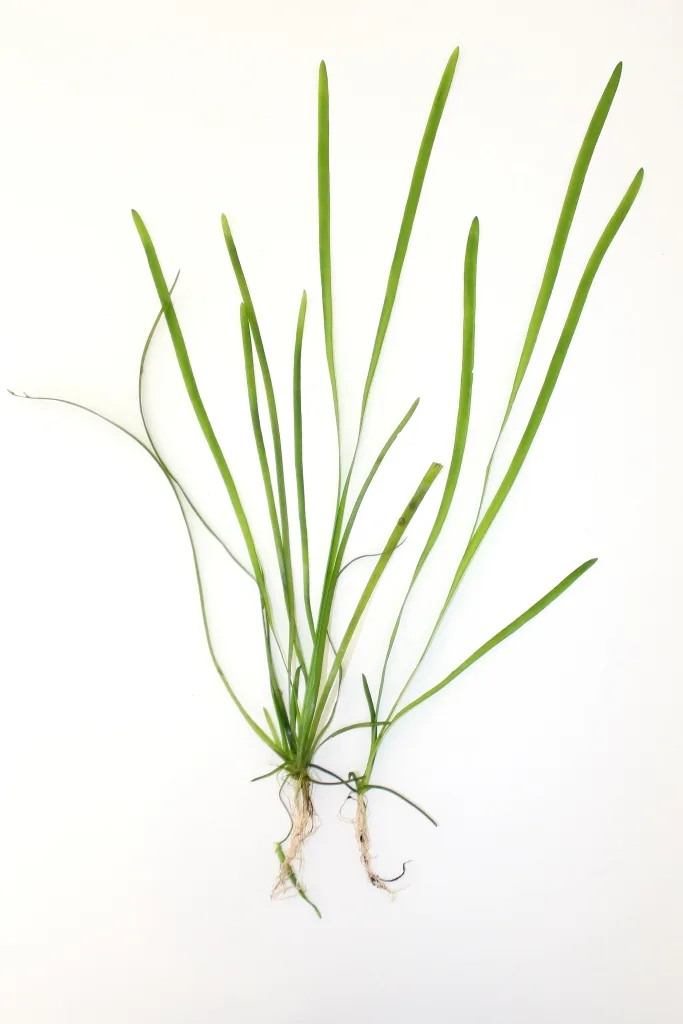
Vallisneria Spiralis
Vallisneria spiralis
Europe, Asia, Africa
5 to 7 Vallisneria crowns planted across the back wall, spaced 8cm apart. They send out runners and fill in to a dense ribbon-like screen of green over three months. Long curving leaves create a natural backdrop and break up the eye line for the school in front.
Background-midground: Java Fern on driftwood
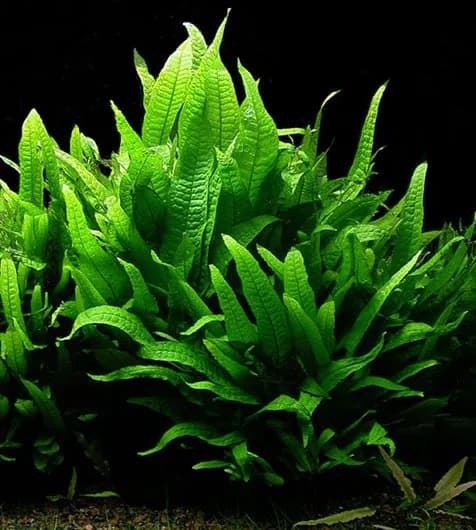
Java Fern
Microsorum pteropus
Southeast Asia
A single piece of Java Fern attached to a tall driftwood spar (60cm or so) at the rear-centre of the tank. The plant grows up the wood, eventually reaching the surface, and serves as a vertical centrepiece. New plantlets that form on leaf tips can be detached and attached elsewhere.
Midground: Cryptocoryne wendtii
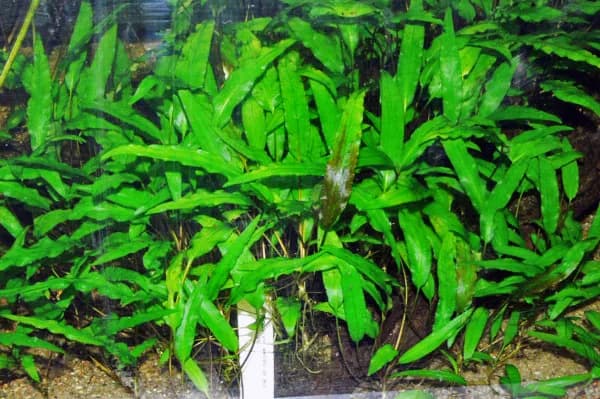
Cryptocoryne Wendtii
Cryptocoryne wendtii
Sri Lanka
5 to 7 Cryptocoryne wendtii plants in the midground around the hardscape. Brown or green cultivar both work. Crypt melt is expected in the first two to three weeks (the plants should stay put), then steady growth as they establish.
Hardscape accent: Anubias barteri nana
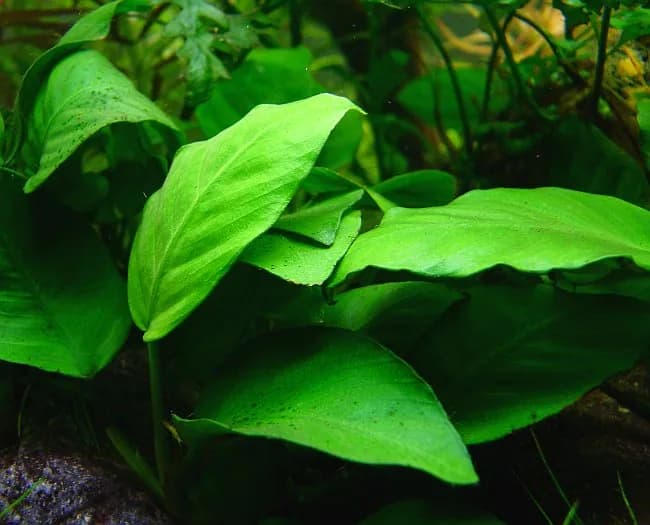
Anubias Barteri Nana
Anubias barteri var. nana
West Africa (Cameroon)
2 or 3 Anubias nana attached to driftwood and stones with cyanoacrylate gel. Placement should put the broad leaves where they catch the light. Anubias never needs trimming and rarely sheds leaves; a hands-off accent plant.
Ground cover and shrimp nursery: Java Moss
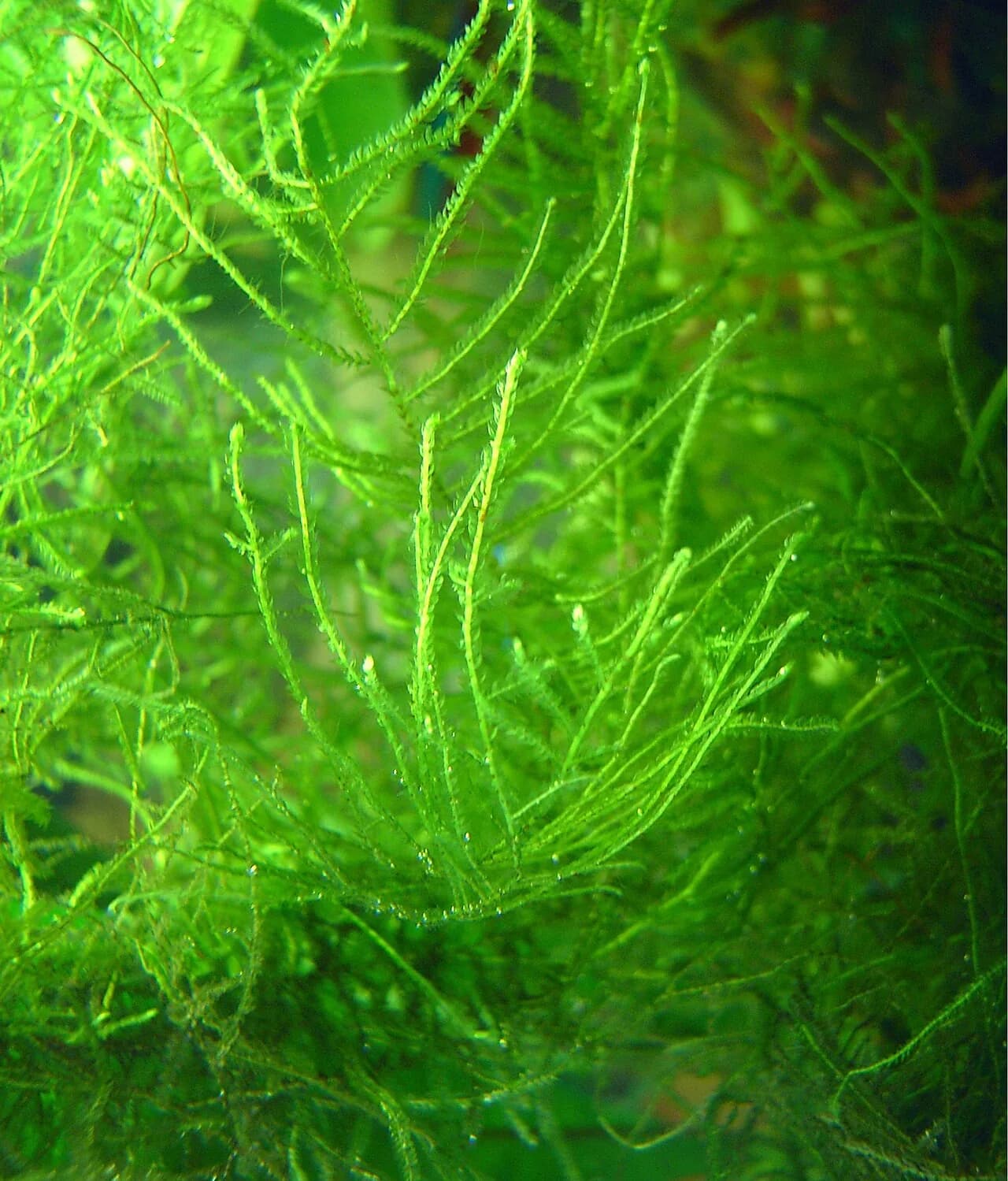
Java Moss
Taxiphyllum barbieri
Southeast Asia
A generous portion of Java Moss attached to a low-back-corner piece of wood. The moss fills in over six to eight weeks, creating a soft green mass that hides shrimplets and traps biofilm. The shrimp colony will breed best with thick moss cover.
For a deeper dive on plant selection, see low-light aquarium plants that don't need CO2.
Equipment basics
What to buy, what to skip.
Buy:
- 60-litre rimless tank. Aqueon, NICREW, JBJ, or Fluval Spec all work. Bowfront tanks should be avoided (visual distortion).
- LED light fixture rated for 60cm tank length. Chihiros A-series, Fluval Plant 3.0, or NICREW SkyLED. Around $80 to $150.
- Sponge filter (Aquarium Co-Op or Hikari) on a 30 to 40 LPH air pump. Around $25 total. Or a small canister filter (Eheim Classic 150 or Fluval 107) with a spray bar return. Around $80 to $120.
- 50W aquarium heater. Eheim Jager is the standard. Around $25.
- 60cm fine sand substrate (5kg dark sand). Around $20.
- Root tabs for Cryptocoryne and Vallisneria. Seachem Flourish Tabs. Around $15 per pack.
- Test kit (ammonia, nitrite, nitrate, pH at minimum). API Freshwater Master Test Kit. Around $30.
- Dechlorinator (Seachem Prime). Around $15.
Skip:
- Powerheads. Too much flow for nano fish and shrimp.
- CO2 system. Not required for this plant list.
- Air stones with diffusers. The sponge filter provides plenty of surface agitation.
- Carbon in the filter. Removes plant fertiliser. Not needed unless medication is being actively removed.
- Goldfish, axolotls, or any cold-water species. Wrong tank.
- Decorative skulls, plastic plants, glow gravel. Bad for a planted tank aesthetic.
Total equipment cost: $200 to $300 depending on choices.
Water parameter targets
The species in this stocking share a comfortable middle-ground parameter window.
| Parameter | Target |
|---|---|
| Temperature | 24 to 26 degrees C |
| pH | 6.5 to 7.5 |
| dGH (hardness) | 4 to 10 |
| Ammonia | 0 ppm (always) |
| Nitrite | 0 ppm (always) |
| Nitrate | <20 ppm |
These match most tap water in soft-to-moderate hardness regions (most of the UK, much of the US east coast, parts of South Africa). Very hard tap water (>15 dGH) may need cutting with RO water 50:50. Acidic tap water (below pH 6) benefits from a small amount of crushed coral in the filter to buffer.
The 6-week setup timeline
Tank setup from box to fish-in is a planned six-week process.
Week 1: Hardscape and substrate.
The tank goes into its final location (moving a planted tank is brutal). Dry substrate pours in first, sloped front-to-back for visual depth. Hardscape pieces (driftwood, stones) get placed and arranged. Photos at the end of day one, then walking away and returning the next day to check whether the arrangement still feels right.
Week 2: Plant placement and fill.
Rosette plants go into the substrate. Anubias and Java Fern attach to hardscape with cyanoacrylate gel. Java Moss presses against a low stone or wood piece, tied with cotton thread. Filling the tank slowly avoids disturbing the substrate (a plate on top of the substrate catches the water; pouring onto the plate works well). Dechlorinator goes in. Filter and heater turn on. Lights on a timer for 6 hours per day.
Week 3: Cycle starts.
A teaspoon of pure household ammonia (3 ppm dose, fishless cycling method) goes in. Water tests daily for ammonia, nitrite, nitrate. The first few days show ammonia dropping as bacteria establish, then nitrite spiking, then nitrite dropping as the second wave of bacteria catches up.
Week 4: Cycle continues.
Daily ammonia dosing continues. Plants are settling in; Cryptocoryne is melting (this is normal). Daily water testing. The cycled tank shows up when a 2 ppm ammonia dose drops to 0 within 12 hours and nitrite stays at 0.
Week 5: Pre-fish settling.
A 50 percent water change lowers nitrate. Parameters get confirmed one more time. The tank should be visually settled; plants growing, hardscape colonised with light biofilm. Plants have stopped melting and started showing new growth.
Week 6: Fish in waves.
Wave 1: 10 ember tetras (or 8 harlequin rasboras). Drip acclimation over 60 minutes. One week of observation before adding more.
Wave 2 (start of week 7): 6 pygmy corydoras. Same acclimation. One week of observation.
Wave 3 (start of week 8): 3 sparkling gouramis. Same acclimation.
Wave 4 (start of week 9): 10 to 15 cherry shrimp. Slow drip acclimation over 2 hours minimum.
Adding fish in waves spreads the bioload spike and lets the cycling bacteria scale up gradually. Adding everything at once is the most common cause of new-tank syndrome.
Where to go next
The planner tool with 60L preset accepts species swaps and shows the stocking math in real time. The compatibility tool anchored to ember tetra shows every species that overlaps with this stocking's parameter window.
Related reading
Every article in the Q1 content plan is relevant background for this stocking.
- Best fish for a 30 litre planted tank (the nano alternative)
- Can neon tetras live with cherry shrimp? (when swapping embers for neons)
- Neon tetra vs cardinal tetra
- Java moss vs Christmas moss
- How many ember tetras should you keep together
- Do otocinclus really eat algae
- Neocaridina vs Caridina shrimp
- Low-light aquarium plants that don't need CO2
Sources
Frequently asked questions
Direct answers to the questions search engines and AI assistants surface most often about this species.
How many fish fit in a 60 litre planted tank?
About 25 to 30 nano-sized fish total in a well-planted, cycled 60 litre tank with appropriate filtration. The classic three-layer community in this guide totals 19 fish (10 ember tetras, 3 sparkling gouramis, 6 pygmy corydoras) plus a shrimp colony, which is comfortable. 30 fish is the practical ceiling and leaves no buffer for stocking errors.
Is CO2 required for a 60 litre community planted tank?
No. The plant list in this guide thrives without CO2. Adding CO2 would speed plant growth but is not required and adds equipment cost. Most aquarists run 60 litre community tanks low-tech.
Can neon tetras and cherry shrimp share a 60 litre tank?
Yes, with dense moss cover for shrimplet survival. Adult neons and adult cherry shrimp coexist fine; the shrimplet predation is the failure mode. See Can neon tetras live with cherry shrimp for the cover requirements.
What size filter for a 60 litre tank?
A sponge filter rated for 60 to 100 litres, or a small canister (e.g. Eheim Classic 150, Fluval 107) on low flow. Powerheads and high-flow internals are too strong; nano fish and shrimp prefer gentle current. The target is 4 to 6 times tank turnover per hour.
How long does it take to cycle a 60 litre tank with plants?
Six to eight weeks if cycled fishless using ammonia. A planted tank with a seeded sponge (from an established tank) cycles faster, sometimes in three weeks. Fish should not go in until ammonia and nitrite both read zero over a full 24-hour cycle.
What is the easiest community to start with?
The stocking in this guide. Ember tetras, sparkling gouramis, pygmy corydoras, and cherry shrimp are all difficulty 1 or 2 out of 5, tolerate the same parameter window, share a temperament profile, and look striking together in a planted scape.